
By the time I came down from the mountaintop in Puma, the energy of my journey around Asia had shifted. With more clarity of mind than I’d had in a long time, I realized that in large part, I had been responsible for the frustrations of my recent travel in China. Having been in the U.S. to file taxes and settle a lawsuit two months prior to departing for China, I had fallen into victim mode, but four short days of living with the Gurungs and learning about their simple, nurturing culture had restored my serenity.
At the end of my home stay in the Gurung village I clambered aboard a rattletrap bus for the five hour ride to Pokhara Nepal, and crammed my too-big butt into a seat made for narrow-hipped Nepalis. The pancake-thin layer of ticking in my seat cushion was soon compressed against the underlying metal and I squirmed, trying to find a comfortable position. Finally, I stuffed my sweatshirt under my tush, but neither the uncomfortable seat nor the waves of gritty brown dust billowing through stuck-open windows could destroy my contentment. Not even when the bus stopped dead in the suburbs of Pokhara, with traffic backed up for miles by a fatal motorcycle accident, did my mood waver.
Initially my buttocks just ached, but when all feeling disappeared, I slung my backpack over my shoulder and hopped out the open door to the ragged street, walking a kilometer down the road to check out the extent of the snarl. Eardrum-splititng horns pierced the air as I zig-zagged through vehicles sprawled helter-skelter down the highway. I skittered out of the way of motorcycles that zipped through chinks in the clogged traffic and stepped gingerly over steaming piles of dung deposited by sacred cows that nonchalantly munched on brittle grass growing alongside an oil-slicked, garbage-strewn canal that paralleled the road.
Plastic bottles, orange peels, and scraps of paper were strewn across the landscape. In the midst of the trash sat a beggar woman in tattered rags, her crinkled brown eyes telegraphing depths of despair. Holding an infant to her breast with one arm, she pleaded for small change with her other hand, holding five fingers together at her mouth in the universally understood sign for hunger.
As the buses became unbearably hot and muggy in the midday sun, more and more passengers joined me on the road. I nodded and greeted each with a “Namaste,” pressing my palms together at my heart in the traditional Nepali greeting. Twig thin men with grizzled beards and red-rimmed watery eyes looked out from beneath their topis – the traditional head wear of Nepal that resembles a soft, crushed fez – and returned my greeting with broad, gap-toothed grins. Herringbone vests and striped shirts topped loosely pleated trousers, beneath which protruded dust-clad feet. Those who had served as trekking guides were easily identified by their crunched-up toes, made so by years of gripping rough mountain trails wearing nothing more than thin rubber flip-flops. Contrasting with the muted browns and grays of the men’s garments, women were wrapped in brilliant saris that paired colors and patterns that would be incongruous in the western world, but somehow here seemed to match perfectly.
Asia is an assault on the senses for the uninitiated western visitor. Fortunately, having traveled in Asia for years, I have learned to look beyond the trash and incessant noise and appalling poverty. Instead, I saw a magical landscape bathed in crystalline light where men squatted on their haunches beneath Bodhi trees to exchange the day’s news, sleepy dogs curled in pools of sunshine, half-naked children playing gleefully in dirt patches, and families laughing together in front of clay-plastered houses, their arms thrown about one another as they soaked up late afternoon sun.
Over the next few days, the magic of Pokhara Nepal worked its spell on me. I walked three miles along the shores of Phewa Lake, bantering with the Nepali merchants and fending off offers of marriage from the Kashmiri shop owners. Each morning I bought fresh-picked oranges from insistent Indian boys on bicycles who hawked the sweet, juicy fruit from filled-to-the-brim circular wire baskets mounted to the rear of their bikes. Tibetan refugees, their hand-strung beads and prayer wheels spread on tarps, sat cross-legged on the sidewalk pleading, “Just take a look.” I learned their names and their stories. Many of them had fled Tibet during the war in 1959 just ahead of the Chinese army, which destroyed thousands of monasteries and killed hundreds of thousands of monks as they advanced. The Buddhist Om Mani Padme Hum followed me through the streets, fading out as I moved away from one music store and picking up where it had left off as I approached the next one, as if the serene chant was piped throughout Pokhara.
One morning I took a boat across the lake to a tiny island that is home to Barahi Temple, the most important Hindu religious site in Pokhara. The temple represents the force of Shakti, the Hindu mother goddess who is the origin of universal creativity and power. Shakti assumes several forms, including a boar called Barahi that has sharp tusks designed to pierce her enemies and protect the gods from demons. Barahi is pictured with the face of a boar with a cup in one hand and a fish in the other; in deference to the goddess, no fishing is allowed in the waters surrounding the island and the fish, perhaps sensing this protected zone, swarm to the shores of the island. Hindus from around the world climb into colorful wooden boats and are paddled across the lake to receive blessings from the priest and have a “tika” – a red mark made by powdered pigment mixed with water – placed on their forehead.
Can’t view the above slide show about Phewa Lake & Barahi Temple in Pokhara, Nepal? Click here.
Another day I arranged for a taxi to pick me up at 4:30 a.m. for the drive to the base of Sarangkot, a vertiginal green hill on the northern end of Phewa Lake that separates Pokhara from the Annapurna Himalaya range. The taxi driver took me as far as he was allowed to go on the rough dirt road and I picked my way up the rocky path by the dim light of my flashlight until I found a stone stairway a few hundred feet further on the right-hand side. Challenged by my poor night vision, I stared at the ground as I mounted the steep steps so as not to trip and fall down the mountain. An hour later, gasping for breath, I reached the small temple at the summit just as the first rays of sun lit up the snowy peaks in shades of orange, gold, and purple, while the river valley below glistened a rich, dewy green.
Can’t view the above slide show about trekking to the top of Sarangkot at dawn in Pokhara, Nepal? Click here.
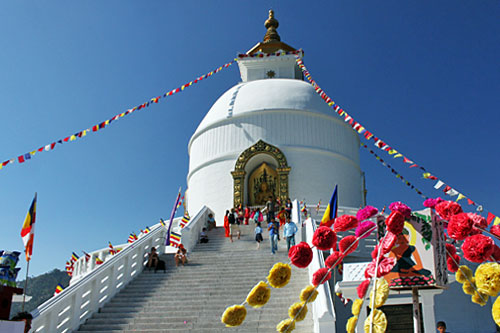
Though Sarangkot at dawn was stunning, others had insisted the view from the World Peace Pagoda was even better. I rode to the top on a motorcycle, my arms wrapped tightly around my guide as we bounced from boulder to crater, hanging on for dear life. At one point the road was so steep and rocky that I had to dismount and walk up the incline. Near the top, the road ended and we made the final ascent on foot via a well-trod dirt path; 20 minutes later we reached the crest and stepped up onto a broad manicured lawn, at the end of which a brilliant-white Buddhist stupa soared skyward. From its perch on a narrow ridge high above Phewa Lake, the World Peace Pagoda offered the same sweeping panorama of the Annapurnas found at Sarangkot, but with the added beauty of Pokhara and the sapphire blue lake cradled in the valley below.
Can’t view the above slide show about the World Peace Pagoda in Pokhara, Nepal? Click here.
Despite the adrenaline rush of the motorcycle ride to the World Peace Pagoda, with the wind blowing through my hair as we glided back down the mountain with no brakes or engine running, I still preferred the early morning view at Sarangot, but this trio of sights was just the beginning of a love affair for me…Pokhara Nepal had captured my heart in a way that few other places in the world have ever been able to.
This post is part of the Carnival of Cities for June 1, 2011, a roundup of stories about fascinating cities around the globe from some of the world’s best travel writers.
Considering a future visit to Nepal? You’ll want to check out my Essential Travel Guide for Pokhara, Nepal, which is updated regularly.

Sounds like things haven’t changed in Pokarah since we spent quite a bit of time there back in ’96-97.
It, like nearly all of Nepal is a stunning area, filled with amazing people, glad it left a mark on you.
Hi K & E: You are so right, it left a huge mark on me. I don’t know if ti’s
the same as when you visited because I heard many locals express concern
that it would be just like Kathmandu in 5 years, but for me it was perfect.
Barbara, I can honestly say reading this post helped me actually feel what you were describing. Along with the vivid mountain scenery you’ve taken me to a place I’ve physically never been – loving your recent posts on Nepal. The effect it’s had on you can be felt in your words.
Thank you so much, Anil. Those words coming from you are really a high
compliment. I am so glad I could convey just a tiny percentage of what I
feel about Nepal. It is a truly spectacular place.
Your writing is spellbinding. I was glued to the screen. What a pilgrimage! Isn’t it amazing what Asia – especially India, Nepal and Sikkim – does to us? Every time I wanted to force something – it didn’t work. As soon as I learned to go with the flow it became a breeze…and I fell in love. I so long to go back.
Have you made a decision yet? In any case, I wish you all the best for what ever adventure you plan for 2011 and beyond. Just don’t stop writing 🙂
Fida: I agree wholeheartedly, that India and Nepal teach us special lessons
that cannot be learned anywhere else in the world. As yet, haven’t been able
to come to agreement on the job offer, and it really looks like it won’t
happen, but I suspect I will base in Nepal for much of the year, at least
for the short term. I am, as you say, going with the flow. Wishing you a
very Happy New Year.
Ah that is lovely to read – I am happy for you that you have found somewhere to give you peace and good feelings.
Thank you David, and happy holidays to you!
Pokhara looks and sounds absolutely stunning! It must be wonderful to find such a special place.
Hi Sophie: Pokhara is now officially my favorite place on the planet. It
does, however, have all the problems of most Asian destinations, including
trash and noise and stray dogs, etc. But if you can look past that, it is an
absolutely wonderful place with amazing people.
I don’t know Barbara. You think you give up on those marriage proposals from Kashmiri shop owners too quickly? They sound like men of commerce with real property.
Well, Dr. Tom, most of them are VERY cute! But they’re also the kind who
have notches on their guns, if you catch my drift. And there’s only so many
Pashmina scarves I can wear.
Barbara,
This blog post was perfect reading for the day before the big holiday (Dec. 24th) for me here in the San Francisco Bay Area. Reading about the beggar woman, “her crinkled brown eyes telegraphing depths of despair,” and about the trekking guides who had made their living by scaling mountains in flip-flops really put things into perspective. My loved ones and I are so blessed, and all of the materialistic things are so unimportant. I realized this on an intellectual level of course, but being drawn into the world you described, really picturing what it’s like for some many in the world, really made me feel it.
As I continued to read your blog post, I felt a sense of peace creeping up on me. I think it was a combination of the writing and the photos that left me feeling as if I had taken a mini escape in the mountains of Nepal. So thank you, Barbara. Your blog post was just what I needed this morning. 🙂
Oh Anis, you have made my day! This whole issue of happiness has been much
on my mind of late. When I go back to the States, I am on sensory overload.
Just walking into a grocery store and seeing the long aisles crammed with
choices makes my head whirl. We are so materialistic in the U.S. and seem to
measure our happiness by material possessions. We don’t feel good enough
unless we have the newest car, the big home, etc. In developing and third
world countries around the globe I meet people who have very little in the
way of material possessions, yet they seem to be so much happier that we
are. The fact that I have managed to convey the simplicity and happiness
that exists in Nepal through my words and photos makes me very happy.
Wishing you a very Merry Christmas.
It seems like a magical place and I love the idea of simple experiences like an hour treking in darkness to see the dawn
Hi Donna and Heather: I have so much to write about Pokhara that I hope you
won’t become bored with me. It’s a very special place.
From your photos and words, it’s obvious that Pokhara has truly caputred your heart, Barbara. A lovely read. I’m looking forward to more.
Wow, I soooo wanta go there now, amazing!!!
Well, Global Butterfly, I’ll be back there in late February – maybe we can
meet in Nepal!
Barbara you make me want to go back to Pokhara. I’ve never been able to spend that much time in the place to really see the sites. I’ve always treated Pokhara as my oasis after a few weeks in Puma or a month of hiking on the circuit. All I want to do when I get there is pamper myself and eat!
The landscape views are spectacular!
Hi ottsworld: I think that is the case with so much of the world. We see things meant for tourists because we’re there for such a short time and don’t really get to know the place at an intimate level. I was so lucky in Pokhara to meet wonderful people who are now lifelong friends; in fact my Yoga guru and his family have adopted me and I consider them my Nepali family (but you will read more about that later). More and more I am coming to realize how the local people we meet really define our travel experiences and because of this my travels are slowing down more and more. But again I have to say that I never would have been here at all but for your advice and help, so I owe you a real debt of gratitude because Nepal, and especially Pokhara, is one of the world’s special places.
Prior to reading your post, I had never heard of Pokhara, but I must say, I think I may be in love. The vibrancy of the city really pops from your pictures and words. Great story! — Randy
Hi Randy! Dont know if you’re in love but I certainly am. Haven’t really Pokhara captured me so but it certainly did. Thanks so much for your comment.