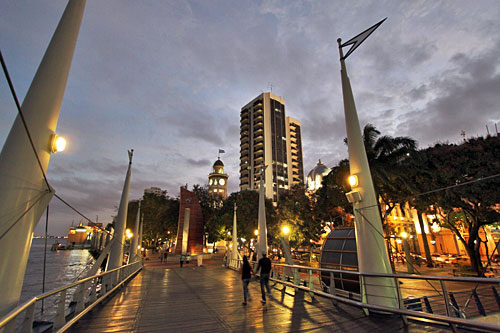
After checking into the Oro Verde Hotel in Guayaquil, Ecuador I asked for a map of the city center. The concierge hesitated for a moment before unfolding one on the countertop. He marked off the sites of interest: museums; the Malecon 2000, a broad boulevard dotted with gardens, restaurants, playgrounds and theaters that runs for miles along the Guayas River; and the 444 steps of Santa Ana Hill that lead to a lighthouse and chapel at the top. “Please allow us to arrange for one of our taxis when you are ready to go,” he finished. When I explained that I preferred to walk he grew concerned. “Then you must stay on the main street, El Neuve de Octubre, that runs past the hotel,” he insisted. “And you must not go out alone at night.”
The next morning I walked briskly past the two black-suited, stone-faced, earbud-wearing security guards in the hotel lobby and onto the main street. Alert to possible danger, I was immediately aware of a massive police presence; in the three blocks between the hotel and a cellular phone store I counted 18 police officers, many wearing bulletproof vests, while private security guards manned the entrances of banks and retail stores. Minutes later, armed with an Ecuadoran phone number for my iPhone, I extracted my camera from my backpack and continued toward the Malecon 2000. Before I’d gone a block I was flagged down by a policeman who politely suggested that I stow my camera. “I’m a photographer and it’s my job to take photos,” I patiently explained. He was somewhat mollified when he learned I had a local phone. “If anything happens, you must dial 101. It’s the emergency number here in Guayaquil.”
All around me businessmen walked to their offices, customers streamed in and out of retail stores and mothers pushed infants in strollers. The city didn’t feel dangerous to me. Mystified, I stopped several different officers and security guards along the way, asking the same question of each, “Is it safe for me to walk here alone?”
Guayaquil, the largest city in Ecuador, is also reputed to be the most dangerous and violent city in the country. Because it is the economic engine for the nation, Guayaquil has attracted a large number of immigrants from surrounding countries, as well as poor, rural Ecuadorians who have flocked to the city in search of opportunity. The Internet is rife with reports of assaults, robberies, rapes and kidnappings and both the U.S. State Department and U.K. Foreign and Commonwealth Office contain strongly worded notices about the dangers of Guayaquil. Lonely Planet’s Thorn Tree Forum contains scores of stories from visitors who have been robbed and/or assaulted. Generally, these warnings do not alarm me; I have visited dozens of supposedly unsafe cities around the world and discovered the dangers are almost always exaggerated. However, the unprecedented police presence in Guayaquil gave me pause.
Interestingly, the officers I queried were in disagreement. Some asserted that I would be perfectly safe in the well-patrolled tourist areas, while others insisted I should not walk alone anywhere in Guayaquil. Since that was not an option, I redoubled my usual watchfulness and set out to discover what the city had to offer. The Malecon 2000 is well-lit and filled with locals who patronize the restaurants, attend concerts, and bring their children to play in the extensive playgrounds after work each evening. I spent a good deal of time there and never once felt unsafe walking along the river, not even after dark.
Can’t view the above YouTube video of the Independence Day celebrations in Guayaquil? Click here.
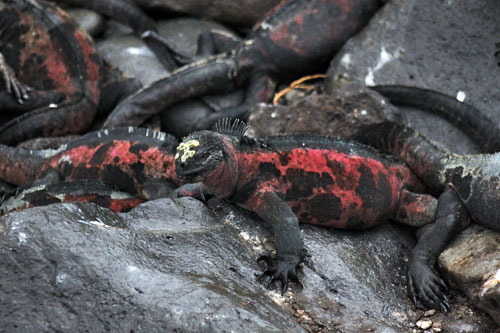
Later that afternoon I stopped by Parque del Centenario to watch the iguanas begging water and ice cream from families seated on park benches. Across the plaza, crews were setting up a sound system for a performance of the Banda Blanca de la Armada de Equator, the Navy Band of Ecuador. By chance, I had arrived during the 10-day celebration of the Independence of Guayaquil. The first city to cast off the shackles of Spain’s domination, Guayaquil’s resistance set in motion revolutions all over the country and is considered to be the roots of Ecuador’s independence. The orchestra struck up a number and I joined the crowd, watching with amusement as a young boy and a slightly inebriated Guayaquileno lip-synched to the patriotic number belted out by the band’s vocalist. Viva Guayaquil! echoed across the square at the end of each number. I joined el grito – the scream – that resounded throughout the country during the struggle for independence. Viva Guayaquil!
Can’t view the above slideshow of Guayaquil, Ecuador? Click here.
One day I opted to explore Santa Ana hill, a neighborhood at the end of the Malecon 2000 where vibrantly painted casitas sprout from the slopes of like bunches of Dutch tulips. One block beyond the staircase leading up Santa Ana hill I spotted a lovely old church with a rose-colored facade. Flagging down a nearby security guard, I inquired if it was safe to visit the church. After a moment’s consideration he said yes, but advised me to watch my belongings. Unmolested, I took a few shots of the church’s exterior but upon stepping inside I was followed by a middle-aged woman who attempted to strike up a conversation. No hello, how are you; no niceties. The only thing she wanted to know was how much my camera cost. Continue reading


United Kingdom
France
Morocco
Czech Republic
Slovenia
Croatia
Hungary
Romania