
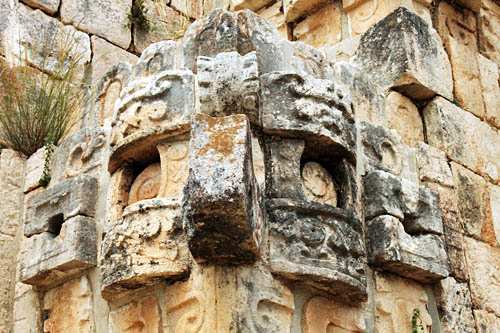
The demonic eyes in the stone mask stopped me in my tracks. This was Chac, the Mayan rain god, the most important deity in a land where the only source of fresh water was infrequent rain. I could easily imagine its hawk-like beak flaying the flesh from my bones. The stone visage guarded a stairway leading to a doorway atop the Pyramid of the Magician in the Mayan ruins of Uxmal. Beyond the door, which Mayans believed to be the mouth of Chac, high priests ripped out the heart of human sacrifices with a flint knife, before throwing their bodies back down the steep steps.
Uxmal, one of the most important cities of the Maya empire, is located just an hour south of present-day Merida on Mexico’s Yucatan peninsula. Located away from regions of heavy rainfall and the jungles that smother the ruins of Palenque, it stands with all its walls erect, almost as perfect as the day it was deserted by its inhabitants. Perhaps because Uxmal is in better condition than many other Maya sites, very little archeological excavation and research has been done on the site, however archeologists estimate that up to 25,000 residents lived in Uxmal at the zenith of its development during the Late Classic Mayan Period, from 850 to 925 AD.
Archeologists also speculate that Uxmal may have been more of an arts community than a governmental center, which could in part account for its stunning architecture. The Pyramid of the Magician, soaring 117 feet high and built on an unique elliptical base, is actually five superimposed temples. It anchors one side of the Nunnery Quadrangle, so named by Spanish Conquistadores because its 74 small rooms reminded them of nuns’ quarters in a convent. The western building’s facade is decorated with entwined stone serpent images, ubiquitous in the Maya world, which symbolized birth, change, and crawling though time. Even the latticework designs are thought to represent the diamond pattern on the rattlesnake’s skin.
Deeper into the site is the Governor’s Palace, an impressive three-level building with a 320 foot long mosaic facade featuring 103 stone masks of Chac, and the Great Pyramid, which offers panoramic views of the entire site from the top. The latter contains some of the more mystifying carvings in the complex; although said to be birds, many of the stone sculptures more closely resemble beings from outer space.
Can’t view the above slide show of Uxmal Mayan ruins in Mexico? Click here.
In the end, all the deities, the human sacrifices, the religious carvings were for naught. By 1000 AD the city had been abandoned, leaving present day visitors to imagine what life must have been like during the apex of the Mayan empire. Uxmal ruins are open every day from 8 a.m. to 5 p.m., and offer a Light and Sound show that begins each evening just after sunset. Though the audio portion of the show is in Spanish, it is worth the $10 price of admission just to see the light display. To reach Merida by car travel south on either Highway 261 or State Highway 18. Public buses also run to Uxmal, but to see the sound and light show, sign up for a guided tour in Merida.

Wow – 25,000 people – that’s amazing to think about. Oh how I wish we could have a time machine to go back and see how they really lived!
What a lovely post Barbara. I visited Mexico many years ago, and a few temples (Palenque, Tulum, Tehotihuacan). However, since part of the journey was through Guatemala I missed Uxmal (well, many other sites indeed).
You made me thinking at going back to Mexico and discover new places, as Uxmal…
I thoroughly enjoy your writing and ability of telling the story. I always learn something new. First when I read and heard you talking about the sound&lightshow I thought that might be a little kitschy in these beautiful ancient ruins of Uxmal, instead, it looks magical.
What a magnificent temple site – I wonder if in centuries to come tourists will wander around the centre of New York among crumbling tower blocks overgrown with trees and vegetation?
This place looks stunning, great pictures and good information about the history and how to get the best out of a visit
Seeing cathedrals, palaces, temples and the like, I am always taken by the incredibly detailed carvings and patterns – each one must take days of detailed work and there are often hundreds and thousands of them. I also recall a great piece of advice about son et lumiere shows as they are often called – a fellow hostel person told me to pay your money, forget the “son” and simply enjoy the “lumiere”. Sounds like Uxmal is similar.
Barbara,
Great post as always! It’s such good news that the Instituto Nacional de Antropologia e Historia is so serious about protecting cultural sites such as Uxmal! I do have one question, however. Is letting tourists climb on the monuments causing any kind of wear and tear on them?
The ruins at Uxmal offer a fascinating look at history. Like many other pre-modern sites in the Americas, I’m fascinated at why they were abandoned. Excellent post. Enjoyed the video and photos as well.
I am enjoying these recent posts so much. You know I’ve been reading them for weeks and weeks now, and it only struck me, reading this, just how much I have learned from you about Mexico. Given the seemingly-ever-increasing bad headlines relating to Mexico these days, it is such a relief to know that the entire country isn’t suffering in the same way, and great to know that inspite of all the problems they are focused on maintaining and researching these links to the past.
Hi Islandmomma: I was extremely impressed with the condition of all the historical/national park sites I visited in Mexico. Their Instituto Nacional de Antroplogia e Historia (National Institute for Anthropology and History – INAH) is a force to be reckoned with. All over the country I saw work-stop permits pasted on historical buildings where the owners had attempted to do something illegal or without permits – I even saw a church with one of those orders slapped on the front of the building! The Mexican government obviously realizes the value of their cultural sites and they could not have been more well managed. Even the smallest, most remote, out-of-the-way ruins had clean, modern facilities and were well marked with information placards and maps.