
Often, my strong urge to travel has to do with seeing something before it disappears. For years I felt that way about going to Africa; I wanted to go on safari before it was too late to see the animals in the wild. I was painfully aware that in many areas of Africa where ecological consciousness is non-existent, poaching and loss of habitat have resulted in animals being added to the endangered species list, if not brought to the brink of extinction. Thus I was delighted last year to discover that the animal populations in Africa seemed to be thriving, at least in the areas where I visited.
I feel the same way about the shrinking rain forests around the globe. Researchers now tell us with certainty that climate zones will shift and some climates will disappear completely by 2100. Tropical highlands and polar regions may be the first to disappear, and large swaths of the tropics and subtropics will reach even hotter temperatures. I sometimes feel desperate to visit the great rain forests of the world before they are gone and so I was most interested to read about a project of the Boyce Thompson Institute for Plant Sciences at Cornell University that is attempting to restore the tropical rain forest ecosystems in Costa Rica.
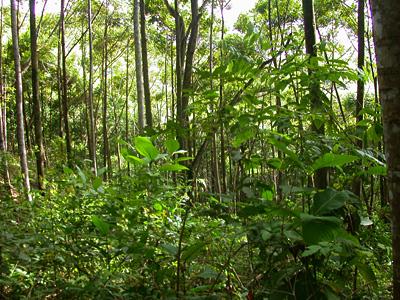
In 1993, researchers began replanting a parcel of worn-out pasture land. For 50 years the soil had been compacted under the hooves of grazing animals and its nutrients washed away. They trimmed away the pasture grasses so that the trees could take hold and planted mixtures of fast-growing local tree species, collecting seeds from native trees in the community before hungry monkeys beat them to it. After just five years, averaging about six feet of growth per year, those first trees formed a canopy of leaves that shaded out the grasses underneath. Ten years after the initial plantings, the species of plants growing in the shade numbered more than 100 in each plot and many of the new arrivals were also found in nearby remnants of the original forests.
The benefits of the project are more wide-ranging than just restoring a beautiful tropical rain forest. The process also helps to control erosion and improve the quality of life of the local people. Researchers point out that drinking water becomes more readily available when forests thrive because tree roots act as a sort of sponge and prevent water from running off hills and draining away.
Fully rescuing a rain forest may take hundreds of years, but the mere hope that we may be able to accomplish this restoration gives me tremendous hope that it is not too late to save our fragile and beautiful Mother Earth.
Planning international travel in the near future? Check out prices for your preferred destination at Booking.com, Hotels.com, or HotelsCombined.com. Read what travelers have to say about properties in your destination at TripAdvisor.com.
Disclosure: This article contains affiliate links to hotel booking sites. If you click on any of the links and make a booking, I may earn a small commission, which keeps this blog free to read.

Our family is considering a summer vacation probably in July of 7 – 10 days to Costa Rica. Since my 15 year old son and I are fair skin complexion, we will probably avoid the beaches and spend most of our time in the mountains, rain forest, and visiting San Jose and other central valley towns. Now I’ve read that the rainy season starts in May or so….and continues to about November. We can tolerate a little rain during the day…but our concern is that perhaps it will be TOO much rain. Should we wait and visit during the drier season to get better better weather since most of our time will be outside?
save the rain forest1!!!!!!!
We know that , there is a problem ahead and we are not doing anything to solve the issue.
In India u grow something in a barren land , if it is useful some (expletive deleted by author) will take it in a blink of an eye.
Yah it’s really good to take good care of our Rain forests. They had a big role in our lives..
“God is clever, but not dishonest.”
I think it is an interesting information that I heve been read, Thanks to let me write a comment in your page.
Hazel