
Very few things in life frighten me, but by the time I arrived in Pokhara, I was scared. My left hip and knee had never fully healed from an injury sustained in Mexico earlier in the year and as a result even an easy trek to Nagarkot and day hikes around the mountain village of Puma had aggravated my knee so badly that I was in pain for days afterward. Panicked that my hiking days were over, my imagination went into overdrive with visions of wheelchairs and four-legged walkers.
Part of the problem was that I had stopped practicing Yoga. I love being a digital nomad but staying in hostels, especially when I am in dorms, has its drawbacks, the greatest of which is the lack of enough room to do Yoga. I could count on one hand the number of times I had attended a class over the past year and I knew it was time to get back to a dedicated practice.
Fortunately, Pokhara is rife with Yoga studios. After two lame classes with poorly trained teachers, I finally found the Annapurna Yoga Ashram and Guru Narayan Prasad Dhakal who custom designed a Yoga practice for me that completely realigned my hip and knee and restored my structural integrity. Over the next six weeks I became such a fixture in his home that, to my delight, Guru and his family invited me to be a part of Bhai Tika, the brother/sister tika ceremony held on the final day of the five-day long Nepali festival of Tihar.
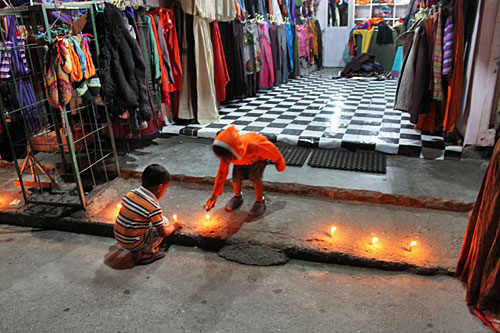
One of the most dazzling of all Hindu festivals, Tihar is also known as the Festival of Lights. As the dates for the celebration approached I began noticing changes around town. Flickering candles and oil lamps began appearing on the stoops or were hung from the walls and ceilings of homes, stores and businesses. This custom reenacts the ancient Hindu legend about a king whose astrologer told him that a serpent would come to take his life away. When the king asked if there was any way to escape death, the astrologer advised him to sleep with lit oil lamps all around his bed and decorate the palace with oil lamps on the day when the goddess Laxmi was to be worshiped. In return for being so honored, Laxmi persuaded the serpent to spare the king’s life but Yama Raj, the god of the underworld, still had to be convinced that it was not yet the king’s time to die. Yama opened his ledger to where the king’s remaining age was written as zero but the serpent cleverly put a seven before the zero and the king lived for seventy more years. As a result, during Tihar Nepalis worship both the underworld and the goddess Laxmi.
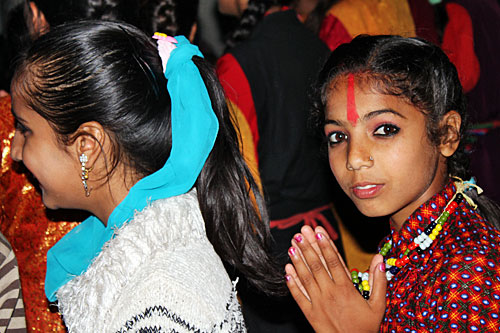
Early in the morning on the first day of the festival, known as crow’s day or Kag Tihar, the Dhakal family placed birdseed and dal bhat (rice and lentils) on the roof of their house for crows, believed to be the messenger of Yama Raj, the lord of death. On day two, dog’s day or Kukur Tihar, prayers were offered to the dog that guarded the gate to the underworld, as this is thought to divert destruction away from worshiper’s homes. Following these prayers, every family honors a dog by placing a tika (a mark, usually red, made by applying powdered pigment) on its forehead, hanging a floral garland around its neck and feeding it a meal of dal bhat. Like most Nepalis, the Dhakals have no pets, so they hunted down one of the hundreds of skeletal strays that roam the streets of Pokhara and temporarily adopted it. On this one day of the year, all the strays in town wandered about in a daze, sporting bright red tikas, flower leis, and bloated bellies.
On the morning of the third, most important day of the festival, cows were worshiped. As the national animal of Nepal and the most sacred animal for Hindus, a cow symbolizes wealth and is considered to be the mother of the universe due to its milk producing ability. As with the dog, one of the cows that meander through the streets of town unmolested for most of the year was captured long enough to apply a tika to its forehead, place a garland around its neck and feed it a meal. Those performing a cow puja (a religious ritual) may also place her manure in different parts of the home, drink a drop of the cow’s urine and even dip a blade of grass into the urine and sprinkle it on each others body.
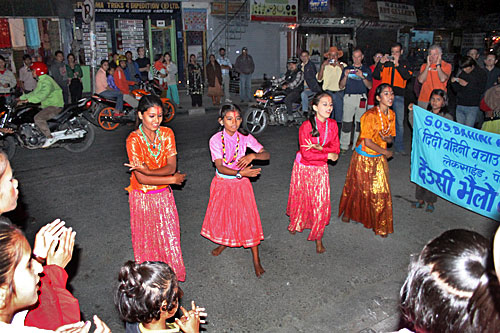
That same evening, pictures and icons of Laxmi, the goddess of wealth, were displayed in an area of the house dedicated to worshiping gods and a puja was performed at dusk using flowers, incense, fruit, and silver coins. Outside, the initial trickle of candles and oil lamps had swelled to thousands, turning Pokhara into a flickering, glittering jewel. Troupes of girls wandered from home-to-home and business-to-business long into the night, chanting a Bhailo or Bhailini, a special song used only during Tihar. They performed traditional dances in the dusty street, forcing traffic to divert around them and the crowds that had gathered to watch the shows. After the performance a tray for donations was passed, earning the girls five or ten Rupees from store owners.
Ceremonies on the fourth day differed according to the particular deity worshiped by each family. My Yoga family reenacted the ancient legend of a village that refused to pray to Indra, god of rain. Angered by the villagers refusal and set on their destruction, Indra brought heavy rains that flooded the village, but one of the three most important Hindu gods, Lord Krishna, lifted a hill named Govardan, allowing villagers to escape the flood waters. On the fourth day of Tihar the Dhakals, in honor of Krishna, made a model of Govardan from cow dung inside their home.
With each passing day of Tihar I had grown more excited by my invitation to join my Yoga family for Bhai Tika, the brother/sister tika ceremony on the final day of the festival. On the morning of the fifth day, soon after I arrived, the two daughters, Himrekha and Annapurna, began stringing garlands of fresh picked marigolds and small purple flowers. The finished leis were placed on a hand-woven tray, along with cracked walnuts, fruits, water, oil, and a collection of multi-colored pigment powders and glitter that would be used to produce tikas. Each family has its own particular tika design; my Yoga family’s signature was a rainbow colored vertical stripe that began at the top of the forehead and stretched to between the eyebrows.
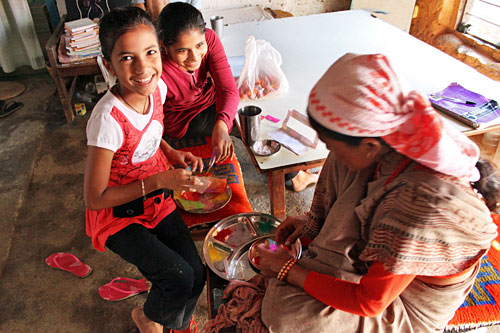
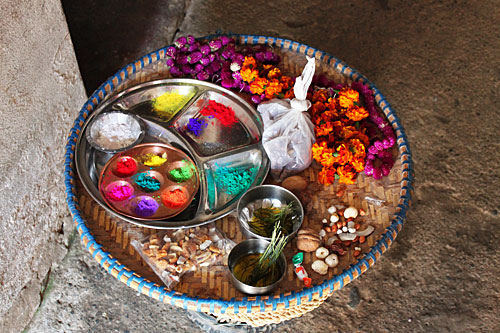
Finally, with preparations complete, the official ceremony began with the application of a rainbow tika above the door leading into the kitchen. Pranab, the older brother, sat cross-legged on a carpet while his two sisters, Himrekha and Annapurna, walked around him three times in a clockwise direction, dripping oil and water on the floor. After they anointed his head with a few drops of oil, Guru Narayan created a pattern for the tika by tearing a horizontal strip in a green banana leaf. Guru held the pattern on his son’s forehead while his sisters carefully applied a base of rice paste through the cutout, then dabbed dots of colored powder on top. When they were satisfied with their work, Guru peeled off the banana leaf, leaving a perfect rainbow tika on Pranab’s forehead. While offering a prayer that the enemies of their brother get lost, the girls placed a flower lei over his head and gifts in his lap. The siblings then switched places and Pranab applied rainbow tikas on his sisters’ foreheads.
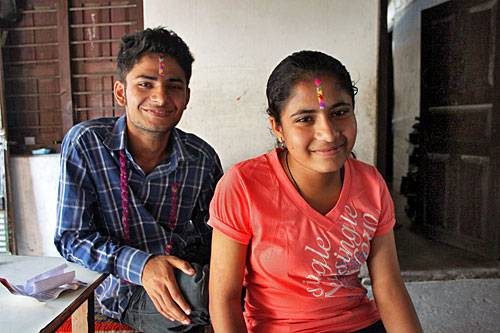
I was happily filming away when Guru motioned for me to put down the camera; it was my turn to sit cross-leggged on the floor while bhai (younger brother) painted a rainbow tika on my forehead. As Guru applied the rice paste paste, the girls pointed to my forehead, giggling and chattering in Nepali.
“What’s so funny?” I demanded from behind the banana leaf plastered to my head.
“Your skin is the same color as the rice paste!” declared Annapurna.
“It is like strawberry ice cream,” added Himrekha.
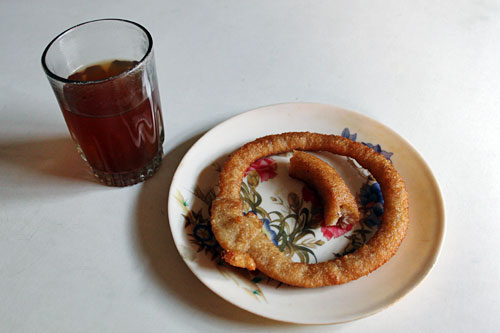
With my tika completed, I exchanged places with Guru and helped create one on his forehead, after which we spent the rest of the day stuffing ourselves with fruit, candy, nuts, Selroti rice rings that resemble giant pretzels, and a traditional Nepali meal of pickles, dal bhat, spinach, and curried vegetables.
Without fail, meeting people and learning about the local culture has always created the most memorable travel experiences for me, so it was with enormous gratitude that I thanked my hosts for inviting me to be their older sister – didi – for a day. Guru gently corrected me:
“You are not didi for a day; you are part of our family. You are didi to us forever now.”
I was touched to the core and had to fight back tears as I left. Not only have I been restored to health by my fabulous Guru, I have gained an adopted family. The gods have truly blessed me.
Considering a future visit to Nepal? You’ll want to check out my Essential Travel Guide for Pokhara, Nepal, which is updated regularly.

Nepal tihar min Brother and Sister tika ceremony .
Barbera did what no one had done before : describing this festival so picturesquely ! It was as live as it could be . Although I am a Nepali living abroad (close to Pokhara) I can see the light being lit, the music being played — still not sure whether I am in America or in Nepal. Amazing …
Dear Rabin: You cannot possibly know how much your comment meant to me. Writers try to evoke the senses in a way that makes the reader feel they are right there, in the scene. You have paid me the highest possible compliment! Thank y ou so very much. As you can probably tell by my writing, I love Nepal and Nepali people and can’t wait to go back every year.
“Our guests are our God’s ambassadors, so welcome them ( Atithi debo bhawa ).” is an old Nepali saying. Carry my best wishes when you go back to Nepal next time.
Beautiful writing… missed home badly (been away from home for past 4 yrs for study.. cant wait to go back this yr for bhai tika!!)
just wanted to add few more information to ur blog… as u’ve described above the way people celebrate the festival is different… our family celebrates 4th and 5th day slightly bit differently…
4th day- we call it mha puja (mha ;dont know if thts the correct spelling for it, anyway mha meaning own body/urself, puja meaning worship) the day kicks off with worshipping the ox, its also new yr’s day for us so throughout the day new yrs celebration goes on, n during the evening we worship ourself, beleiveing tht we ourself are god in various forms,beautifully decorated with coloures,flowers mandala are made for each member of family and the family members are seated according to the hirearchy; , and the eldest female member starts the ceremony by worshipping lord ganesha, and continues on with worshippin the family member,
5th day- also called kijapuja(kija meaning brother)its almost the same thing as u’ve mentioned in the blog only difference is we dont swap positions with our brothers; only sisters put tika into brother’s forehead and we dont circle our brothers with oil and water 3 times, we design n decorate mandalas for each of our brothers and worship them,
i’ve tried to write as much details as i can, some of the families celebrate the festival both ways,
loved reading ur blogs
cheers
Roshani
Hi Roshani: Thanks so much for sharing your family’s version of the Tihar
celebrations. My adopted family told me that each family has a specific form
of celebration, dictated by the Hindu God that they worship, so I wasn’t
surprised to read about the different traditions. I particularly liked the
idea of the mandalas – lovely! Hope you make it home to celebrate with your
family this fall!
Beautiful, touching post, Barbara!
What a lovely story. Is it the same festival as Diwali in India, or a separate festival?
Hi Theodora. It’s the same festival as Diwali, or Dipawali, as it is
sometimes spelled, in India.Tihar is just the Nepali word for the
celebration.
That looks like a great festival, thanks for sharing your experience with us!
what a wonderful experiences… made me think about going back to nepal… last time i was there was just plain “get-the-indian visa-and-head-out”…
Oh wow, Flip, you missed a lot if you quickly passed through Nepal! Do go
back if you have a chance; it’s wonderful!
As for all of Nepal, I just love the colour and strong sense of community in these wonderful festivals, of which there seems to be so many. To be such a part of the festival sounds a very treasured and special experience.
Fascinating – I can’t get the image of the dogs out of my mind. It must be quite a sight and change for both them and everyone around 🙂
Anil – the dogs wander around in a dazed and confused state, as it’s
probably the only day of the year they don’t have to scrounge through the
garbage for food.
Really a good experience you faced in Nepal.Hindu Community celebrate many festivals and enjoying these festivals with them is amazing experience.during my travel to India there is awesome festival name Diwali.I really enjoyed it and suggest other travelers to travel to India during Diwali festival and it is celebrated in each and every part of India.Thanks for such a nice post Barbara.
With love
Johny
Thank you Johny: Actually, Tihar (the holiday I celebrated with my adopted
Nepali family) is the same as Diwali in India – Tihar is just the Nepali
word for the holiday. So I definitely believe you that Diwali is a great
festival! Thanks for stopping by.
Nice description of a wonderful ceremony. It looks like you are really enjoying Nepal. It is a marvelous place. Congrats on your new family members as well.
Jason
Thanks Jason. I have to leave soon for my next travel destination and I’m
going to miss it a lot!
How fascinating, and how many beautiful people you are meeting and traditions you are witnessing in Nepal. I need some Yoga too, I used to do it and I abandoned due to my constant moving around. There are many classes in Shanghai, I’ll have to join some, since my sitting in front of a screen most of the time is already giving me back problems!
What an amazing time to be there and get the chance to experience that festival!
What a great opportunity to really experience Tihar. I was there with my dad in Puma during Tihar in 2009 and it was fascinating. All the kids would come to Didi’s and sing and then they’d get rice or other food goodies.
So happy your knee is doing better – next time I’m in Pokhara I need to go!
I must say I admire you for your courage and it seems it has been fully rewarded:) Having been through similar experiences, I must say that I’ve arrived to the idea that it’s the people that make those places worth the travel.
It definitely sounds like the gods and goddesses have truly blessed you! What an experience!!!
Barbara,
There’s nothing scarier than losing one’s health, so I am so glad to hear that you were healed! Yoga, I’m convinced, is one of the most powerful healing activities known to man.
Nepal sounds so exotic and foreign when I think about it; but I found when I was watching the video of the Tika ceremony – the little girl learning to crush the nuts and the family members watching while the family’s own particular version of the tika was painted over the doorway – I realized that families in Nepal aren’t so very different from ours in North America and Europe. We all have much-anticipated holidays with special traditions and stories that we pass on through the generations. We decorate our homes a certain way, eat certain foods and observe certain ceremonies. And we celebrate these holiday traditions as a family.
My favorite part of this blog post, however, was the fact that not only were you invited to the ceremony, but you were officially adopted as the family’s didi! Thank you for sharing your very special travel memory with us. I read a lot of travel-related publications and see a lot of advertisements for luxury accommodations and “ultimate luxury” experiences. Reading blog posts like yours reminds me of what is really special about travel – the opportunity to connect with the local people and immerse yourself in their culture. Congratulations on your new position as didi!
Anis! I have long been of the opinion that people everywhere are much more
alike than we are different. We all have the same hopes and fears, love of
family and friends, etc. It’s one of my goals to convey this message in my
writing whenever I spend time immersed in another culture. So glad it came
through loud and clear and thanks so much for your comment.
Hi Barbara, I liked the way you explained things – these stories were taken for granted since I grew up with them. Congrats for being a didi – did they tell you the responsibilities associated with this position? hehe 🙂
Priyank.
Hi Priyank: NO! They did not. Would love it if you would elaborate. They
have been so good to me I would love to know there is a way to return the
favor.
What an extraordinary experience! And glad your ‘bhai’ helped aligne your hip and knee. It’s always amazing what one can achieve with Yoga!
What I wonderful experience. I can only begin to imagine how you feel about it. The whole point of your travels I guess.
Hi Fida and Islandmomma: So glad you liked it. The Dhakal family was just
one – albeit a large one – of the many reasons I’ve fallen in love with
Nepal.