New Travel Anthology, 65 Things to Do When You Retire: Travel, Raises Funds for Cancer Research
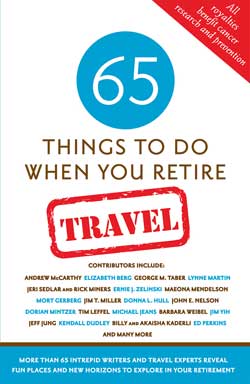
Last year I was contacted by author Mark Chimsky, author of 65 Things To Do When You Retire, an anthology of short essays by prominent retirees such as President Jimmy Carter, Gloria Steinem, and Mort Greenberg which The Wall Street Journal called “one of the year’s best guides to later life.” On the heels of that widely acclaimed first effort, Chimsky was planning a follow-up book named 65 Things To Do When You Retire: Travel. He asked if I would be willing to provide a story for this second anthology. Since the royalties generated from the sale of this book will be donated to nonprofit organizations dedicated to preventing and curing cancer, I was delighted to do so.

65 Things To Do When You Retire: Travel was released last week. In it, more than 65 writers and travel experts reveal their own personal adventures and offer practical advice about how retirees can have the time of their lives, whether traveling with a group, spouse, partner, or on their own. The essays describe glorious getaways, the best places for retirees to visit (or relocate), how to plan for a “great escape” without breaking the bank, or, as in my case, how to enrich your travel by making a local connection. Other contributors include
Days of Wine and Roses and No Baths in the Loire Valley

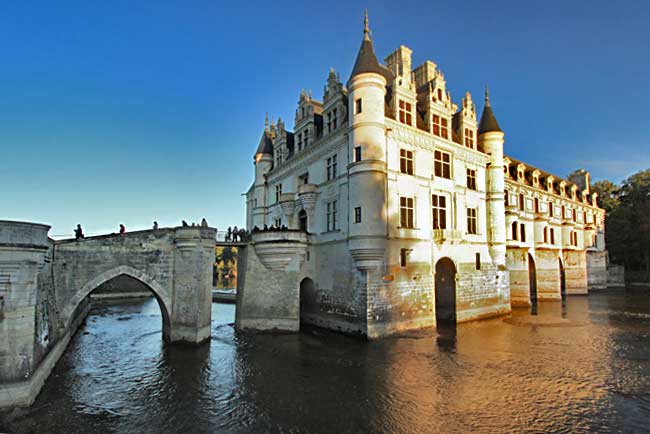
France-Loire-Valley-Chateau-de-Chenonceau-Bridge

In the latter half of the 15th century, events conspired to create a perfect storm in France. The Hundred Years War with England drew to a close and, in 1494, King Charles VIII returned victorious from his invasion of Italy, bringing with him the Italian Renaissance. which valued cultural achievement above all. The mighty Medieval fortresses of the Loire Valley, no longer required for defense, were converted into stunning chateau designed for recreation and pleasure. Embracing the Renaissance philosophy that valued culture above all, monarchs and noble families filled these palaces with stunning artworks and furnishings and threw lavish parties that spared no expense.

Hundreds of these chateau still dot the Loire Valley, many of which are open to the public. With only three days in Tours, I opted for back-to-back morning and afternoon van tours that would allow me to see four of the most famous. We began at the smallest, Chateau de Clos Luce. Though not stunning in the manner of grandiose, multi-turreted chateau, this castle is notable as the place where Leonardo da Vinci, who had been induced to leave Italy by King Francis I, spent the last three years of his life. It was the perfect setting for da Vinci, who wanted to be away from people, in a peaceful atmosphere that allowed him to pursue his scientific work. Today, the low buildings surrounding the gardens contain reproductions of da Vinci’s inventions and his Mona Lisa, one of three painting he carried upon leaving Italy for France, hangs in the Louvre Museum in Paris.