
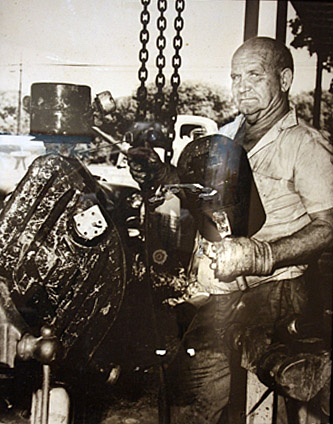
Like many artists, Stanley Papio was never fully appreciated until after his death. A former boxer, horse groom, and Army veteran, Papio made his way to Key Largo in the 1940’s and settled on a cheap piece of land right next to the highway, where he built a salvage and welding business. In those early years no one cared that he filled his front yard with junk. The Keys had not yet been discovered and Papio’s nearest neighbor lived 15 miles away. But when developers arrived the surrounding property sprouted with fancy homes and residents began to complain about the old washing machines, cars, toilet bowls, and scrap metal heaped in piles around his plot. All that “junk” at the entrance to Key Largo was an eyesore. No one cared that Papio had been there first.
The town hounded him to remove the junk and bring his property up to code. He refused to comply, instead creating sculptures welded together from his treasured junk and displaying them in his front yard. Papio considered his sculptures more political statement than art. His work, which often represented actual people, enraged members of the Garden Club and the Monroe County Commission and landed him in jail on six different occasions.
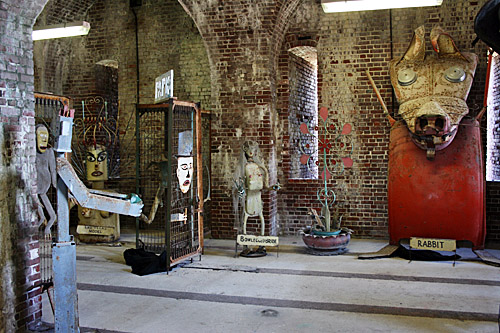
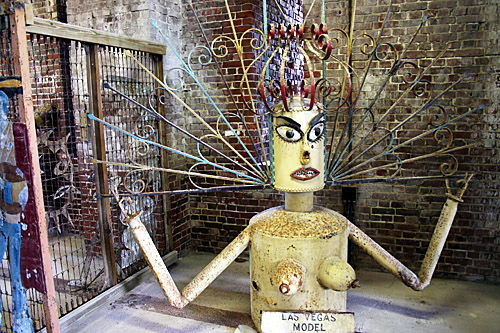
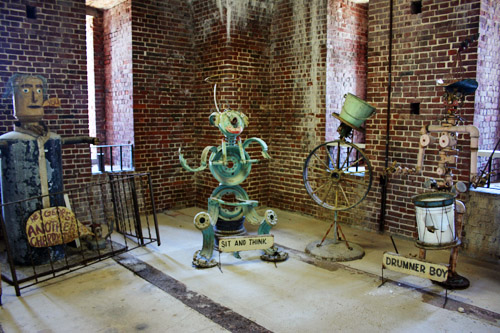
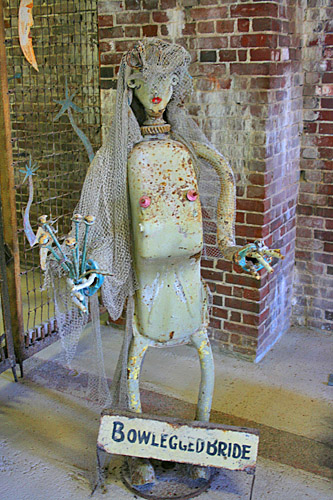
Papio’s sculptures eventually were acclaimed; pieces were exhibited around the U.S., as well as in Canada and Europe. Art fans regularly arrived to browse his creations and tours began adding his “gallery” to their itinerary. Yet Papio refused to sell his art, at one point turning down an offer of $7,500 from a museum for one of his pieces. Instead, he hoped to donate everything to a museum that would be willing to display the entire collection. Papio got his wish posthumously; after his death in 1982, the East Martello Fort and Museum in Key West agreed to display his works in the central citadel at the fort.
The sculptor’s works are scattered through three floors of the gloomy citadel. Like the fort, many of his sculptures are deteriorating in the damp salt air, but perhaps that is the way Papio would have preferred it. For whatever remaining time they are with us, his works provide a fascinating historical social commentary on the people and society of the Keys.

I moved my family to the Keys in 1970 and admired Stanley’s Junque Art from the get go. I stopped on the way home from Homestead one day just to admire his work up close and we chatted a bit. At the time I didn’t have the nerve to offer to buy a piece of his and put it in my neighborhood. Yard Art was not yet very popular for the faint of heart. That art is not lost: It is living and well on Nanatucket, MA. Sorry I couldn’t send you jpeg file.
Hi Betsy: Thanks so much for sharing that with me. It must be wonderful to have an actual piece crafted by Stanley.
I walked with him thru his property back in the ‘70’s and he explained his sculptures (as long as I fed him cigarettes). He showed me a creation of an arch of rainbow painted metal that descended into a toilet bowl and told me that it was the pot at the end of the rainbow…the one that MOST people GET. He kept the reviews and accolades of his art in an old refrigerator. What a Keys Character !
A character indeed, Kathleen! How I envy you having met him in real life.
He was a great and unusual Man,I was only 14 in 1969 when my family move 6 houses down from him. I help him many times pulling up weeds in the yard, I was now seating home remembering the best years of my life,
In 1971 I was working as a plumber at what is now known as Ocean Reef Resort. I purchased a used 1966 Chevy Impala from a co-worker knowing it needed a new transmission. I bought a used one and in the process of installing it discovered the yoke was about 6 inches longer than the original one. The old yoke would not fit, so the only alternative was to go with what I had and shorten my drive shaft by six inches. I was familiar with Stanley’s shop as I drove pass it twice daily going to work. One evening after work I drove up to Stanley’s place and told him that I needed him to cut 6 inches out and weld it back, and asked if he had time to do it aad what it would cost me. He said to begin with it would cost me a six pack of Budweiser. I left the drive shaft with him and headed to the nearest convenience store and picked up a six pack. When I got back the shaft was still laying in the exact place I put it. He insisted that I sit down and have a beer with him. I liked him instantly and as we drank the beer we talked about everything. In no time we were out of beer so I left to get some more. This time I came back with two six packs. After a little while it was about dark and I was getting a little high. I finally told Stanley he needed to get my little project done so I could get on home. He eventually got up and walked over and measured 6 inches and cut it out. The cut was terrible. What we call an alligator cut . He didn’t grind it square or even knock the slag off. He put the torch down and sat back down and grabbed another beer and we picked the conversation up where we had ended it. This went on until we finally ran out of beer. It was around 10 pm now and I had to work the next day and told Stanley I had to go and did he want me to come back and pick the shaft up later. He said no, he would finish it now. He got up off of his chair and stumbled over to his welding hood and his lead and without using a square,he welded one side, looked down it like it was a rifle. tapped it a time or two with a hammer and completed running a bead around it. I thanked him and had to make him take twenty bucks, and I left knowing damn well that no way would this drive shaft ever be straight and that I was sure I would have to take it to a professional and have it done right. The following weekend just for the hell of it I crawled under the Chevy and installed the drive shaft. It fit perfectly. but I knew that no way would it work without vibrating the car to pieces. Well I decided to try if anyway, at low speed I pulled onto US 1 and headed south. Well no vibration at 20mph. I accelerated on up to 30, then 40, hell even at 65 if floated like a butterfly on the highway. I was impressed and for the next three years drove that car and I never had any problems with the transmission or drive shaft. I occasionally would pick up some beer and drop in on Stanley and we would sit under a little canvas shack on some old car seats in the dirt and find a million things to talk about. I liked him and he was definitely someone who I have remembered to this day. I was 21 when I met him and I am now 67. I left the Keys after a few months but Stanley always comes to mind anytime someone mentions the Keys. He was definitely a character and marched to his own drum.
Hello Don! Thanks so much for your wonderful comment. I’ve had a couple of other people leave comments about their experiences with Stanley, and to a person, they all rave about the kind of person he was. Wish I had known him like you did.
I was on one of my many fishing expeditions in the late 70’s with some friends when we happened to catch an interesting sculpture off the side of US1 in key largo. We stopped in and looked around when a rough voice yelled out what the hell you doing here.We then told him we were welders and really liked his stuff. about an hour and a half pack of cigarettes later we left
He told us about what inspired certain pieces to be created and that he was dying of cancer.
it was interesting and sad, as the next time i looked to the right going down to the keys it was gone. Never to be duplicated ,One of a kind.
Hi Steven: Thanks so much for sharing you wonderful (if a bit sad) story. You were fortunate to meet and spend time with one of the icons of the Keys. You’re right – they’re not making any more Stanley Papio’s any more.
Stanley used to come to my house in Pirate’s Cove, Key Largo, nearly every Sunday from 1979 until his death, for bagels and cream cheese. My partner and I owned a gallery a few miles from his that showcased nautical antiques and art from other cultures. He liked our pieces and we were captivated by Stanley’s “Folk Art Gallery,” as he called it, with its fences made of bedsprings and full of hubcaps. Occasionally we had a creative project whose needs fitted Stanley’s talents perfectly. The best thing he made for us was a welded metal armature for an antique diving suit so we could dress it, put a helmet on it, and use the diver for a roadside attraction sign.
We’d listen to his stories of neighborhood persecution, watch him cadge cigarettes and beer from admiring tourists, and marvel at his wrathful energy as he told the story of each sculpture. If you weren’t a neighbor trying to get him ousted from his property though, he was unfailingly generous and kind. He was also proud of his work and and at the drop of a hat would show you all his press clippings, which he kept along with his beer in an old refrigerator.
Stanley had been taught to weld as a young man in the Canadian Air Force. My favorite quote of his is:”Anyone can weld metal to metal. I can weld metal to rust.”He was an irreplaceable character, and I still miss him.
Oh Gloria, thank you SO much for sharing this story. I love Stanley’s work and was appalled when I learned the history of the community trying to oust him. I spend most of my time overseas, where people are more concerned about having loving families and being good friends that how well-manicured their lawns are. Frankly, I think the creative spirit is slowly being killed in the U.S. The fact that the community could not see his work as art and embrace his as the creative soul he was breaks my heart, and although his works are now being displayed, I worry that they will deteriorate because they are not (or were not, the last time I visited) in a climate controlled setting, and they continue to rust away. How lucky you are to have known him personally. You should write a book!
I met Barefoot Stanley when my wife and I moved to Key Largo in the early 60s to start crawfishing. I was one of a very few that he would allow to go upstairs into what he called “My cave” … me and a few other guys that he allowed to go up there all began calling it “Barefoot Stanley’s cave.” … he was the kind of guy that if he liked you, he would help any way he could…he welded a trap-puller table for me and allowed me to bring him crawfish tails and yellowtail to pay for it…gave me a fuel tank and helped me mount it in the rear of my pickemup truck so I could fuel my boat…gave me 5 gallons of paint for my bouys…on and on and on I could go about all the guys that he helped…I eventually teamed with a crawfisherman and we went offshore to trap crawfish, and ended up moving to Riviera Beach up near WPB…every time my wife, Dottie (died in 2002 after 41 years together) and I went to Key Largo to visit our daughter (who has lived there most of her 54 years) we stopped to say hi to Barefoot Stanley…..when I heard about him welding his odd pieces together and telling the transplanted snowbirds to ‘smooch his mule’ and created an art studio in his yard right next to
A-I-A, I cheered….goodonya….I write books now and have added him in a couple and have added him in my new novel, THE GHOSTS OF CHOKOLOSKEE…. Rick Magers http://www.grizzlybookz.net ….Ole BFS was one of the real Keys characters, and a damned good one too.
Hi Rick: Thanks so much for sharing your connection with Stanley. What a fascinating story!
I knew Stanley, i met him when i was stationed at the missle base in key largo. Myself and two other guys built a car to race in the hobby class at miami speedway this was I think 1969 or 1970. Its been a long time. Stanley let us use his shop an tools to strip and build a roll cage for the car.we worked on this car for 5 or 6 months. We would buy stanley cigarettes and things from the BX on base for letting us use the tools. Stanley was always nice to us. Its good that someone has put together this web site. Thank you.
Hi Jimmy: Wow – thanks so much for sharing that little bit of history. Sounds like Stanley was quite the character. How wonderful that you have those memories of him and appreciate the comment.
how cool is this?? bravo, stanley!
Jessie Voigts’s last blog post..Book Review: The Rough Guide to Florence and the Best of Tuscany