
Though the rainy season was months away, angry gray skies threatened on the morning I was scheduled to travel from Luang Prabang to Nong Khiaw, Laos. As if trying to outrun the impending rain, our maniacal mini van driver sped full bore through packs of children walking to school, straddling the center line as he negotiated blind curves on the winding mountain roads, arriving 45 minutes earlier than usual.
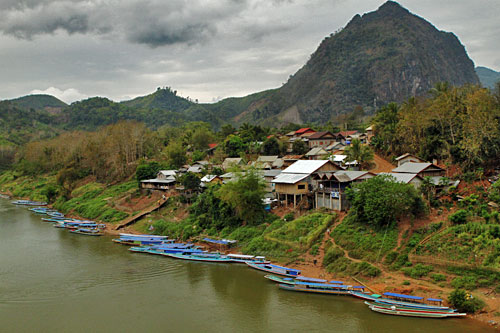
A shuttle bus carried me through town to the other side of the Nam Ou River, where I got the last available room at family run MeeXai Bungalows for 60,000 Kip per night (about $8 U.S.). I kicked my boots off on the porch and threw open the door to my home for the next three nights, an adorable bamboo hut on stilts with an attached open-air bathroom. Sighing contentedly, I sank into the huge mosquito net-draped bed just as the first fat drops of rain pinged the tin roof. With no coat or even a sweatshirt in my backpack I decided to defer dinner until the rain slackened. Instead, I propped myself up with two pillows, pulled the duvet up to my chest and popped open my laptop, determined to catch up on writing. The gentle rain soon turned to a downpour, bringing with it a chill that crept through gaps in the wooden floorboards and open space between the bamboo walls and roof. By 8 p.m. my cold fingers had turned to thumbs on the keyboard; I crawled under the covers and let the thrumming rain carry me off to sleep.
The same staccato music that had lulled me to sleep woke me the next morning. I extracted one arm from beneath the cozy bedcovers and tested the temperature. It was definitely too cold to brave a shower in the outdoor bathroom, but I could no longer ignore my hunger. I shivered into my heaviest pants, three t-shirts and my only long-sleeved shirt and trekked to the nearest restaurant, slipping and sliding in rain-slicked red clay that sucked at my boots. By noon the raging storm was the main topic of conversation in town. Deluges like this are uncommon in Laos; even during the wet season it usually rains for only a few hours each day and the forecast predicted continued rain for the next three days. Superstitious Lao were convinced that this storm was the result of the recent tsunami in Japan and no amount of explanation could convince them otherwise.
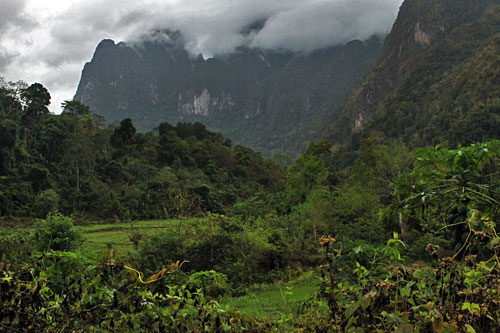
With no chance of the rain abating I seized this opportunity to witness what life is like during the monsoons. Crossing back over the river I strolled down the main street, a sea of ochre that slithered past wooden bungalows painted in vivid hues and storefronts where proprietors hunkered under awnings, shivering in the unseasonal morning chill. A moveable garden of colored umbrellas bloomed over students walking or bicycling to school. Like a painting of an ethereal Shangri-La, jungle-clad limestone hills thrust abruptly up, their muted green humps piercing dull gray skies. Aside from the school children, who shyly returned my Sabaidee – hello – no one smiled or even acknowledged my presence. To the adults, it seemed I was invisible.
Can’t view the above slide show of Nong Khiaw, Laos? Click here.
The following morning I continued my soggy pilgrimage, heading for Pathok Cave. Each time I glanced from beneath my umbrella images of Lao life imprinted on my memory like scenes from a movie. A family of four huddled miserably around a cook stove beneath a bamboo awning, struggling to stay warm. Wrapped from head to toe in a grey blanket, a withered man squatted in a doorway, staring vacantly out at the rain. While for some, rain interrupted the daily routine, for others the weather was simply an inconvenience. Rain streamed off the conical straw hat of a girl carrying twin baskets from a pole strung across her shoulders, keeping only her head and shoulders dry. Two women shoved rocks behind the wheels of their wooden hand carts and began filling five-gallon jugs at a local spring; water, water everywhere and not a drop to drink.
A mile later I squished down a sticky clay path, tentatively crossed a swinging bridge of rain-soaked logs, and slid down a hill, nearly landing in the stream at the base of the hill, before arriving at the cave entrance. A northern headquarters for the Pathet-Lao forces during the Lao civil war, Pathok Cave today bears no evidence of those turbulent times. I climbed the staircase to the dark interior of the cave and groped my way around, using the rock walls as a guide until my eyes adjusted to the dimness. A ghostly girl appeared at my side and touched my forearm. She followed me around silently but when I turned to leave determinedly stuck her hand out and demanded: “Money!“ For what?” I asked, knowing she could not understand me. I turned my back and ignored her but she followed on her bicycle, hurling accusations from her saucer eyes as I retraced my steps to the village.
Unfortunately, this was the norm rather than the exception in Nong Khiaw. Almost every child that I tried to engage in conversation look at me suspiciously and either refused to respond to my Sabaidee, or answered by asking for money or pens. It may be that the soggy weather had dampened everyone’s spirits, or perhaps the seeming unfriendliness of Nong Khiaw has evolved because so many tourists use it as an overnight stay on their way further upriver to Muang Ngoi Neua. Still, I don’t regret the three days I spent shivering in this tiny village. It was a rare opportunity to witness real life rather than they typical scenes afforded most tourists, and the exquisite beauty of the area is undeniable.

Hello Barbara,
I just happened across your blog while looking into information about Ecuador and “Hole in the Donut” struck a chord in my memory. I recalled a rainy evening in Laos, resting in a hammock on the porch of my bungalow, chatting with a seasoned traveler about our travels… And I see that I was correct after finding this entry about Nong Khiaw.
It was a great little village to spend some time in and I started a float down to Luang Prubang in the rain from there. Where I’m from in Alaska we can get 300+ days of rain a year so that storm was particularly refreshing after a couple months of sweltering, dry heat. Coincidentally, I was accompanied on the boat trip down the Nam Ou by 5 other Alaskans, all refreshed by the rain and enchanted by the river life that we observed on our float down…
I recall learning that the Nam Ou was about to be developed for hydroelectric interests and have meant to look into it since then. Do you know what has happened to that beautiful river?
Hi Matthew! Wow – what a memory you have; I’m definitely impressed. I also adored those rainy days. I found it remarkable that others were hurrying away because of the rain, while I thought it provided a special opportunity to meet more of the locals. I hadn’t really kept abreast of the dam projects, so when I got your comment it prompted me to look into it again. I know that China and Lao have plans to build seven dams on the Mekong, but I was saddened to read that they also have plans to build an additional seven on the Nam Ou. This article by International Rivers, one of the premiere watchdog groups, tells the sad story: https://www.internationalrivers.org/campaigns/nam-ou-river. Hope you are well and it sounds like you are still traveling. You’ll love Ecuador. Try the Chugchilan Loop, if you can.
This was fascinating! Also great photos. It must have been so hard to get them in dark and rainy weather. Congrats!
Such a well written article. I will be in Laos in September, during the rainy season but it won’t deter me. And Nong Khiaw is on the list.
I love embracing the rainy season culture. I have so many people that write me worried about going to SE Asia during rainy season – but I tell them that they are lucky becuase they get to see the rain culture – which is quite unique! Glad you didn’t melt!