
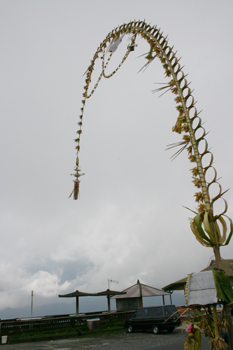
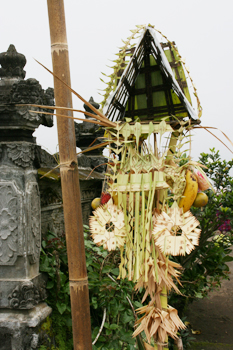
The Balinese don’t celebrate wedding anniversaries. They don’t celebrate birthdays much, either. What they do celebrate is their religion. Hinduism is the center of their everyday lives, which are steeped in religious ceremony and tradition. Towns prepare for temple festivals by weaving intricate designs of young palm fronds onto long bamboo poles, which are then displayed all up and down the streets. Each morning the Balinese weave palm leaves into small baskets, filling them with flowers, fruit, and various other food.
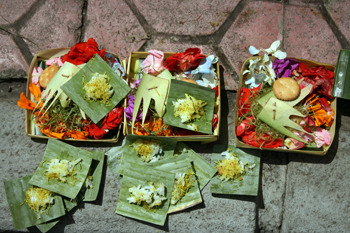
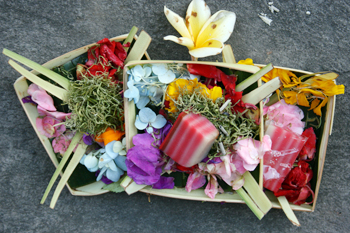
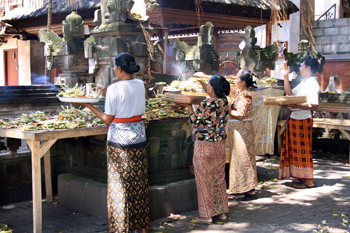
These offerings are left out on the sidewalk in front of the home or shop, placed in the windshield of the car, or placed upon a home altar. There are even groups of women whose job it is to prepare and bless the offerings before delivering them to stores in the market so that the offerings will be fresh throughout the day. By the end of the day the food has been devoured by monkeys, eaten by ants, or picked over by birds and the street is littered with the remains of these offerings. Locals can be seen sweeping them into big piles with long whisk brooms made out of twigs. The next day, the whole process begins anew.
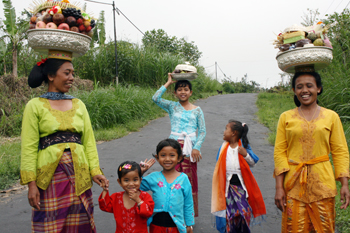
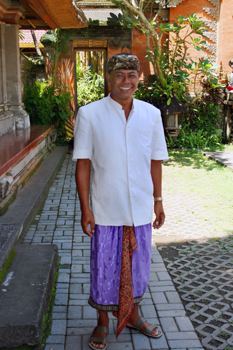
The Hindu religion has a myriad of Gods, however the three most important among them are thought to be Brahma, the Creator; Vishnu, the Protector or Maintainer; and Shiva, the Destroyer. Consequently, every village has three major temples, one on the north side to honor Brahma, one in the center to honor Vishnu, and a third on the south side to honor Shiva. Balinese men and women can regularly be seen walking to temple dressed in traditional garb, carrying huge baskets of fruit and flowers on their heads to be left as offerings to the Gods. The ceremonial garb for men consists of a sarong, covered by a shorter saput, both of which are bound by a sash. On their heads they wear the traditional ceremonial headband, knotted in such a fashion that it resembles a hat. Women wear long skirts or sarongs and either colored bras or strapless bustiers, which they cover with see-through lace blouses.
The colors worn are a clue as to what type of ceremony is taking place. White and yellow outfits are worn for temple festivals, dark garments for funerals, and brightly colored outfits for weddings. After my guide explained this to me I thought I was clever when, later, I spied a man dressed in black and white checked saput with a bright red jacket and headband. “Ah, he must be going to a wedding, with all that colorful clothing,” I said. “No, no, he is in traditional dress of security – he provides security for the temple during ceremonies,” Wayan explained. There are so many nuances to the Balinese culture that it would take years to really understand it.
Ubud, being the cultural and arts center of Bali, is the best place to see performances of the famous Balinese dance. There are at least five different dances to choose from each night. I asked around to find out which was the best one to attend. One of the other guests, who comes to Bali regularly, suggested I hire the front desk clerk, Made, to take me to the nearby village of Batu Bula to see their famous dances. Apparently, Batu Bula is one of the few places where the Fire Walk is performed, and then only twice a week. So I hooked up with Made and we agreed upon a price. He picked me up on his motorcycle at 5:30 PM. We wound our way up and down hills, along curvy mountain roads, reaching Batu Bula half an hour later.
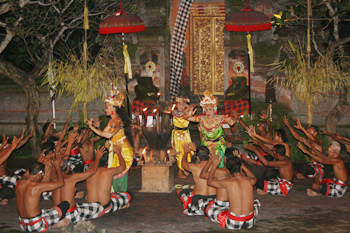
It was during the performance that I really became aware of how very important religion is to Balinese culture. Most Balinese dance, chanting, trance, and singing is a depiction of ancient Hindu legend. In this case the performance told the story of the white monkey, Hanuman, who helped Prince Rama retrieve his beautiful bride, Sita, who had been kidnapped by the demon King Rahwana. This particular performance had no music or orchestra, rather it was accompanied by a chorus of 30 men who chanted in rhythm during the entire hour long performance.
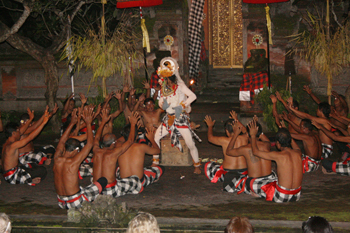
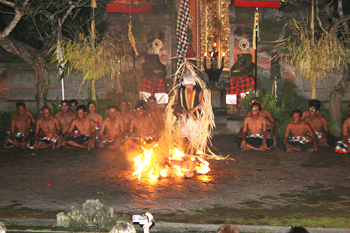
The show ended with the Sanghyang Jaran Dance, where an entranced boy dancer on a horse (the horse being represented by palm frond streamers hanging from a frame that the boy carries on his shoulders) dances around and in a bonfire made of coconut husks. At the end, the members of the chorus pull him out of the fire, lay him on the ground, and quickly remove all the burning materials from his feet, body and costume. It was an amazing spectacle.
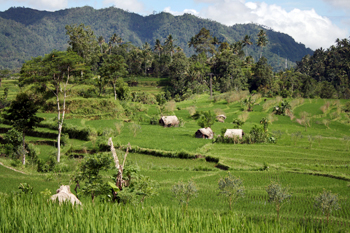
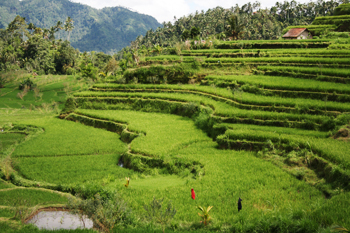
Although I have been trying to change my flight so I can stay here a few more days, I don’t know if I will be successful, so I am headed down to the southern part of the island tomorrow to be near the airport. If I can change it, I will stay in Sanur for a few days, where they have pure white sand beaches. If not, it’s on to Thailand as originally scheduled. Whatever the Gods decree will be OK with me. There is no doubt that I will come back to this island someday – it is such a beautiful place and there is so much I did not get to see. I will leave you with two more photos – yet more rice terraces, but this time in gorgeous full sunlight that showed off the lush greenery to its best advantage.

Nice clicks.. Thanks for sharing it with us.
Luxury Bali Villa
Nice pictures. I can see that Indonesia is a mixture of a great culture and tradition. Looking forward to your upcoming travels.
This is a nice resort. Bali is so filled with many of these exotic resorts. Cliff Front Villas
Good post… charming..
If you have a plan to come back to Bali, we will definitely offer you special discount to stay at our eco-friendly resort Bloo Lagoon Village (http://www.bloolagoon.com.
Please let us know if you have one
Amazing, you’d taken a lot of good photos and travelling a lot.
Welcome to Thailand!!!, hope to see more pictures.
I have been reading your blog for over an hour trying to catch up where I left off the last time. Your pictures are amazing and put National Geographic to shame. I am so excited seeing the pictures and reading about your adventures. Happy Belated Birthday! What an incredible opportunity. I am so envious.
Happy Birthday and Joyful Travels. It’s great to see your pictures.
Peace,
Ruthie and Keith
BARBARA,
IT LOOKS LIKE YOU ARE HAVING A WONDERFUL TRIP. HAPPY BIRTHDAY AND COME HOME SAFE. I WILL CONTINUE TO FOLLOW YOUR JOURNEY.
BE SAFE.
LOVE,
CAROL
Looks and sounds like you are having a greeat time. Wish I had time to read it all but my days at work are even busier now that I have cut back to four days – Thurs. thro’ Sun. Hope I can make it financially with just the four days, I was not doing too well keeping up at home this past few years, and after all I am 72! And, can’t say work here is a snap – we do work! Happy Birthday and hope the weeks and months ahead will be great ones! Enjoy! Love ya! M. Lee
Barb a friend of yours called to speak with you today and I gave her your blog address. She will probably use that because she wanted to wish you Happy Birthday. Sorry but I did not get her name, so I am wishing you Happy Birthday for her. Take care
They say it’s your birthday (East coast time), it’s my birthday 2 (almost)! Happy Birthday! – Charles
I hope they celebrate birthdays — HAPPY SPECIAL DAY!!!
I am a Balinese man who met you in Ubud this afternoon. I gave you my card. Hope you still remember me.
Congatulation for the nice blog you have. I love the pics of the reice terraces.
Keep posting.
Putu