

I’d been riding the bright red double-decker tour bus for less than ten minutes when I realized there was something very special about Lima. At every stoplight, people standing on street corners smiled up and waved effusively; it was obvious that Limeños wanted tourists to feel welcome. At this point, Lima was just an overnight stop, a halfway point on my way to Cusco and Machu Picchu, but I planned to return. Two months earlier, in Guayaquil, Ecuador, I’d shared a hostel dorm room with Karina Gonzalez, a Peruvian schoolteacher on holiday. When her vacation was over, Karina drew me a map of Peru and highlighted the best places to see in her country. “And you must let me know when you are coming to Lima so I can give you a personal tour,” she added. It was an opportunity I wasn’t about to pass up; there’s nothing better than being introduced to a city by an in-the-know local.

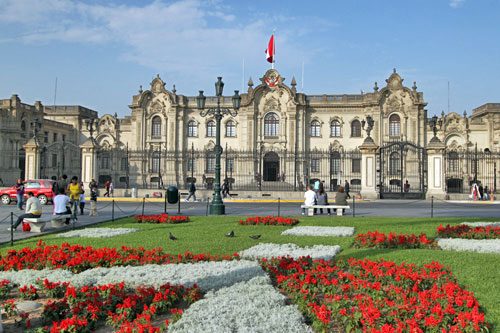
The Government Palace dominates one side of Plaza de Armas in the historic center of Lima
Two weeks later I rolled back into town and called my new friend. The next morning we hopped on an express bus, bound for the historic center of Lima. We stopped briefly at Plaza de San Martin to check out the city’s fabulous new Gem and Mineral Museum before shouldering our way into Jardin de la Union pedestrian mall, where we rode a tidal wave of shoppers into Plaza de Armas. Ivory and daffodil yellow colonial buildings ring this expansive square, which is the focal point of Lima’s historico centro. The stately Government Palace covers one full block, while Lima’s stunning cathedral occupies another. Tucked between these two monolithic structures is the Archbishop’s Palace, with its twin ornate wooden balconies. The design of these balconies, which allowed Spanish ladies to watch the streets below without being seen, is said to have been brought over by conquering Spaniards, who were in turn influenced by architectural styles introduced by invading Moors.

Archbishop's Palace in Plaza de Armas features twin Moorish-influenced balconies
We had made a complete circuit of the plaza and were about to move on when I heard music playing nearby. Down a narrow side street, a brass band blared in front of Rosario Basilica and Santo Domingo Convent as members of the congregation hefted a palanquin containing a flower-bedecked statue of the Virgen de la Puerta (Virgin of the Door). The bearers inched down the street, rocking side-to-side as they bore the sacred icon of their church on their shoulders. Three nuns in pale blue habits with white lace mantillas cascading from their grey heads walked backwards in front of the bier, waving smoking censers. Behind them, a cadre of worshipers danced backward to the beat of drums, their burlap sackcloth and black-painted faces representing slaves that the Virgen de la Puerta is said to have freed. We soon departed, but hours later, long after the sun had set, we ran into the same procession, still carrying the virgin through the streets of old Lima in a remarkable display of faith and endurance.
Can’t view the above YouTube video of cultural performances in Lima, Peru? Click here.
Our good fortune continued for the rest of the evening. At Parque de la Muralla, just a block from Plaza de Armas, we happened upon a performance of traditional dances from the coast of Peru; a short while later we arrived at Lima’s Water Park, which the Continue reading
As my open-air double-decker tour bus turned the corner our guide pointed out Circuito Mágico del Agua, the Magic Water Circuit in Lima’s Parque de la Reserva. Named the largest fountain complex in the world by the Guinness Book of World Records, the water park features 13 fountains, including one that shoots more than 260 feet into the air. I’d only caught a glimpse of the park’s water features, but I’d seen enough to know I wanted a closer look.
A week later, back in Lima after a visit to Cuzco and Machu Picchu, I partnered up with my girlfriend Karina, who lives in Lima, and we headed for a night of frolicking in the fountains.
Can’t view the above YouTube video about Lima’s Water Park? Click here.
From the Magic Fountain, we made our way past the Fountain of Life and the Fountain of Traditions, pausing to admire the unique design of each before ducking through the long Tunnel of Surprises, made up of cardinal red water arches. On the other side we paused for nearly half an hour at the Labyrinth of Daydreams, a circular fountain with alternating wet and dry concentric circles. The challenge was to make it to the center without getting wet, but since there was no way to know when the Continue reading