I’m taking a departure from my normal travel adventures to ask for your help. We sometimes have a tendency to push tragedies out of our minds, dismissing them as having happened so far away that they really don’t impact us. We are compassionate, certainly, but we don’t really do much of anything. Today I had a vivid reminder of just how small the world is when I received an email from a friend of mine who lives on the Outer Banks of North Carolina, where I lived for nearly 11 years. He informed me that mutual acquaintances of ours, Andy and Jean Anderson, are searching for their daughter, Taylor, who hasn’t been seen since the earthquake and subsequent tsunami in Japan.
Taylor is living in Japan, teaching American culture to children in Mangokuura Elementary School in the town of Ishinomaki, which was virtually ground zero for the tsunami. She has not been heard from since the earthquake despite a previous erroneous report that she was found. The State Department is now engaged in the search and there is still hope that Taylor will be found, as many parts of the area are still physically cut off. However, resources are too few and search and rescue teams are confronted with an environment than we cannot imagine. To make matters worse, cell communication is spotty and satellite phones are desperately needed.
The United States currently has American Disaster Assistance Rescue Teams (DART) on the ground but they are not assisting with the search and rescue operations. The Andersons are asking that we all contact our Senators and Congressman and deliver a message that the State Department needs to deploy the necessary resources to find Taylor and any other American still unaccounted for in Japan.
Andy and Jean know this is a long shot, but are trying desperately to pursue every option to find their daughter. If you know anyone in the area or have any thoughts on what to do, please let them know by leaving a comment on this blog. They will be monitoring it. Taylor’s person finder record is http://japan.person-finder.appspot.com/view?id=japan.person-finder.appspot.com%2Fperson.2538296&query=. We all thank you for whatever you can do to assist, even if it just prayers or a few phone calls.
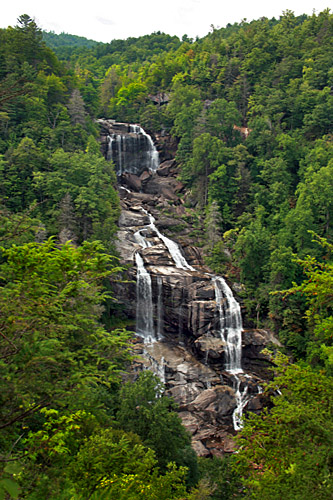
Plunging an amazing 411 feet, Upper Whitewater Falls in southwest North Carolina is the highest waterfall east of the Rockies. Located in a fairly rugged, little-visited area, the upper falls are easily accessible via a short paved path bordered by wildflowers, moss-covered boulders, and dense forest.
After five weeks on the road it was time to head home, but not before one last day of hiking. From the North Carolina mountain town of Cashiers, I mapped a route past Gorges State Park, which opened to the public this past May. Located atop the Blue Ridge Escarpment, this newest North Carolina park is the source of five mountain streams that gradually descend toward the South Carolina border, where they suddenly plunge over spectacular falls and rush through steep-walled gorges.
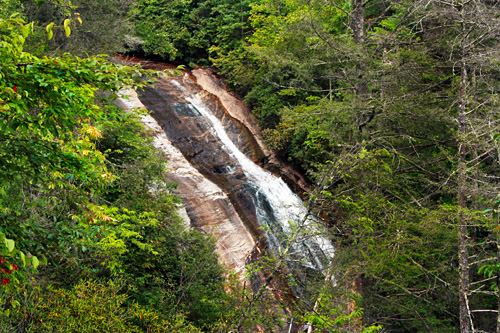
With only one afternoon at my disposal I decided on a duo of one-mile round-trip hikes. The first, marked “strenuous,” descended sharply to a wooden platform overhanging Bearwalow Creek, where Upper Bearwallow Falls dropped 200 feet into the gorge. Pretty – but a bit anticlimactic after others I have seen around Transylvania County. And almost not worth the straight-up, half-mile ascent that had me gasping for air.
After catching my breath I crossed the parking lot to access the “moderate” Bearwallow Valley Overlook trail. I eyeballed the spongy, leaf-littered path Continue reading
Phony teepees, gold panning operations, and stores overflowing with “Indian” souvenirs stamped “Made in Taiwan” dominate the main street in Cherokee, North Carolina. On the sidewalks, performers with not a whit of Indian blood don garish costumes and perform steps bearing little resemblance to actual Cherokee ceremonial dance. In a shopping center parking lot, kids line up to ride a mechanical bull, while down the street, giant arrows direct tourists to a live bear display. Although located within the Reservation lands of the Eastern Band of the Cherokee Indians, it would be easy to dismiss the town of Cherokee as just another tourist trap and drive right on through. But don’t. Instead, turn at the Cherokee Museum and drive to the top of hill to Oconaluftee Indian Village, where an authentic Cherokee experience awaits.

Main highway running through Cherokee, North Carolina is strewn with touristy attractions and gift stores
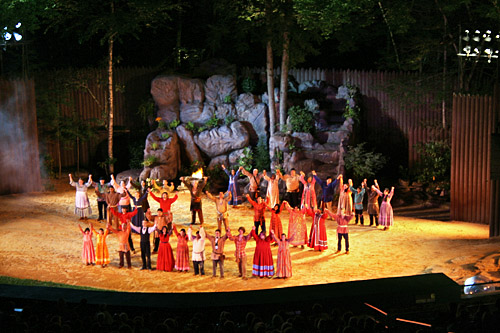
The Cherokees in Western North Carolina today descend from those who those who hid in the hills, defying removal during the infamous Trail of Tears mandated by President Andrew Jackson, and others who returned, many on foot. Gradually they created a sovereign nation of 100 square miles and, in 1948, established the Cherokee Historical Association to carry out their mission of preserving the history and culture of the Cherokee People. Oconaluftee Indian Village and its sister operation, the Unto These Hills Outdoor Drama are central to those efforts. Continue reading
Deep within North Carolina’s Nantahala Forest, a glittering emerald valley is encircled by 5,000-foot high peaks. Sunshine streams down through crisp pine-scented air, illuminating the craggy stone faces of Yellow Mountain, Rock Mountain, and Chimney Top that stand sentinel around the valley. In the surrounding woods, spongy footpaths carpeted with last winter’s detritus follow rushing creeks to thundering waterfalls. Mountain roads snake past wildflower-choked fields, neatly manicured crimson barns, and tiny hamlets on their way to spectacular mountaintop vistas.
What is this mystical place? Have I been magically transported to Eden? No. This is Cashiers, North Carolina, as close to heaven as a mortal can hope to be.

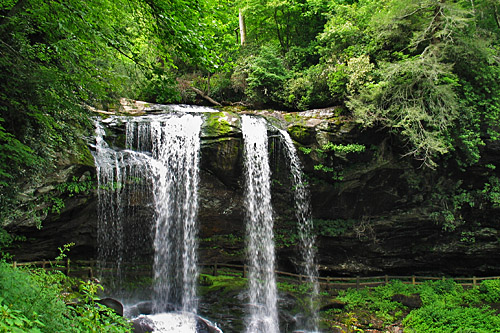
Path allows visitors to walk behind Dry Falls
This tiny town, located at the junction of U.S. Rt 64 and NC 107 in far southwest North Carolina, perches at the southern crest of the Blue Ridge Mountains. With little more than a mile of quaint shops and inns, the focus in Cashiers is on the outdoors. Visitors who are not physically inclined can explore the exquisite landscape with a ride on the Great Smoky Mountains Railroad. The 53-mile scenic rail journey crosses two tunnels and 25 bridges on its spectacular route Continue reading