About Barbara Weibel

Barbara Weibel After years of working 70 hours a week at jobs I detested, I felt like the proverbial "hole in the donut" - solid on the outside, but empty on the inside. Searching for meaning in my life, I abandoned my successful but unsatisfying career and set out on a six-month solo backpacking trip around the world to pursue my true passions of travel, writing, and photography. My blog features stories about the destinations I visit, people I meet, the crazy things...Read more here....
  • Eiffel Tower, Paris, France
  • Angkor Wat Cambodia
    Angkor Wat, Siem Reap, Cambodia
  • Hill Tribe Chief Northern Thailand
    Hill Tribe Chief, Thailand
  • Machu Picchu Peru
    Machu Picchu, Peru
  • Franz Josef Glacier New Zealand
    Franz Josef Glacier, New Zealand
  • Olympic National Park Washington State
    Olympic Peninsula, Washington
  • Damnoen Saduak Floating Market Thailand
    Damnoen Saduak Floating Market, Thailand
  • Maasai Tribe Ngorongoro Tanzania
    Maasai Warriors, Ngorongoro, Tanzania
  • Lion Serengeti National Park Tanzania
    Serengeti National Park, Tanzania
  • Chichen Itza Yucatan Mexico
    Chichen Itza, Yucatan, Mexico
  • Wat Xieng Thong
    Wat Xieng Thong, Luang Prabang, Laos
  • Feast Central India
    Traditional Feast, Central India
  • China Shangahi Skyline Pudong
    Pudong Skyline, Shanghai, China
  • Honeymoon Beach Florida
    Honeymoon Beach, Florida
  • Great Wallof China Jinshanling Beijing
    Great Wall, Jinshanling, China
  • Lake Louise Banff National Park Canada
    Lake Louise, Banff National Park, Canada
  • pura ulun danu temple batur bali
    Lake Temple, Central Bali
  • Galapagos Islands Ecuador
    Galapagos Islands, Ecuador

This entry is part 1 of 3 in the series Seven UNESCO World Heritage Sites of the Kathmandu Valley

Each time I arrive in Kathmandu, I am awed by the kaleidoscope of silk saris that enliven its dusty streets, the canted brick buildings with old wooden doors painted in rainbow colors, and the stoic women vendors who patiently squat next to paltry piles of produce amidst the squalor. But I can only take so much of the seething crowds, the pollution, and the ear-splitting horns of motorcycles that streak through the narrow lanes, passing just inches from pedestrians who share the asphalt. After a week, my senses are overloaded and I flee to serene Pokhara. Because I’ve had to experience Kathmandu in bits and pieces it has taken me three years to see all seven of the UNESCO World Heritage Sites in and around the capital city, but this year I finally visited the last remaining site on my list.

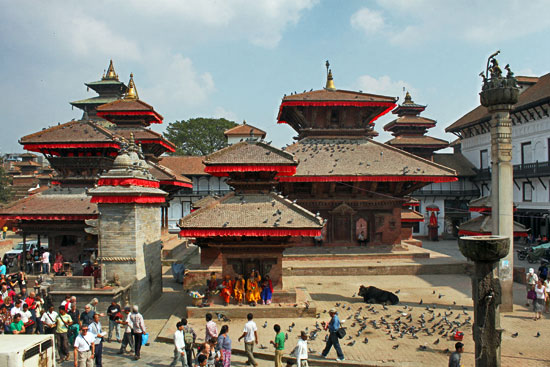
Kathmandu Durbar Square, one of seven UNESCO World Heritage Sites in the Kathmandu Valley, Nepal

Kathmandu Durbar Square, one of seven UNESCO World Heritage Sites in the Kathmandu Valley, Nepal

Kathmandu sits in the center of a valley that is roughly shaped like an oval bowl that legend says was once a lake surrounded by hills. One day, the Bodhisattva Manjushree visited on a pilgrimage and saw a bright flame coming from a huge lotus in the center of the lake. Wishing to worship the flower, he cut a deep gorge in the hills with his sword, allowing the water to drain from the valley. Over the ensuing centuries, three separate kingdoms arose within the fertile valley. The rulers of each constructed magnificent medieval palaces surrounded by plazas known as Durbar (Palace) Square. Today we know these royal cities as Kathmandu, Bhaktapur, and Patan (Lalitpur District). In 1769, Prithvi Narayan Shah conquered and unified the three kingdoms, creating the country of Nepal. Continue reading

This entry is part 2 of 3 in the series Seven UNESCO World Heritage Sites of the Kathmandu Valley

My second annual visit to Nepal’s capital city was less stressful. I knew what to expect and was familiar enough with the city to find my way around. This time I vowed to see all five remaining UNESCO World Heritage Sites in Kathmandu that I had missed the previous year, beginning with Swayambhunath Buddhist Stupa. I hopped on the back of a friend’s motorcycle and we wove our way through Kathmandu’s massive traffic jams to the hilltop site.

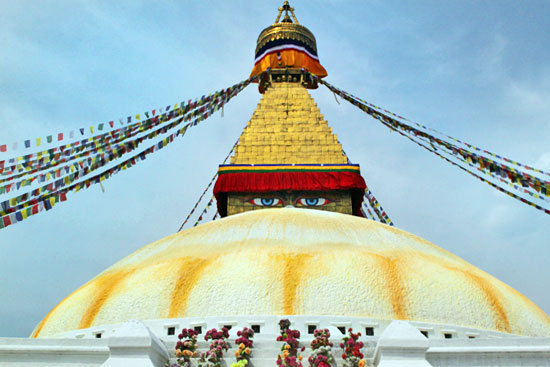
Swayambhunath Buddhist Stupa in Kathmandu, more commonly known as Monkey Temple

Swayambhunath Buddhist Stupa in Kathmandu, more commonly known as Monkey Temple

Swayambunath’s main feature is the Maha Stupa, reputed to be more than 2,000 years old. It’s brilliant white dome, which represents the spotless pure jewel of Nirvana (freedom from the endless cycle of reincarnations), is topped by a 13-tier golden spiral tower. Between the dome and the tower the traditional all-seeing eyes, painted on all four sides of the stupa, gaze out over miles of the city. It’s stylized lotus mandala base is said to be built on the precise spot where the Chinese saint Manjushri saw the flaming lotus floating on the lake that legend says once covered the Kathmandu Valley. Desiring to worship the lotus, Manjushri cut a swath in the hills that surround Kathmandu with his giant sword, draining the lake. Continue reading

This entry is part 3 of 3 in the series Seven UNESCO World Heritage Sites of the Kathmandu Valley

At least one person dies each year at the Bisket Jatra Festival (Nepali New Year) in Bhaktapur, Nepal. This year, I was nearly one of them.

Last year, I had planned to attend Bisket Jatra for two reasons: it is the most elaborate celebration of Nepali New Year in the entire country; more importantly it was the only one of the seven UNESCO World Heritage Sites in the Kathmandu Valley that I had not yet visited. But the gods conspired against me. By the time I had been embarrassed at Boudhanath Temple and forcibly ejected from Pashupatinath Temple, I cut my losses and fled to Pokhara, leaving Bhaktapur for another time. This year, nothing was going to stop me.

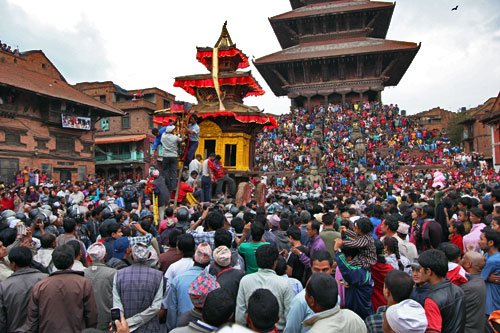
Thousands of people cram into every square inch of the square

Thousands of people cram into every square inch of the square

Bisket Jatra is celebrated over nine days in mid-April in the ancient city of Bhaktapur, center of the Newaris who were early inhabitants of the Kathmandu Valley. For two weeks prior to the holiday, crews decorate an enormous wooden chariot in the center of Taumadhi Square in preparation for carrying the sacred image of the God Bhairav. Considered to be a dangerous deity, Bhairav is symbolically tied to his seat with scores of lengths of reed, which are painstakingly woven around the prow of the chariot where he is seated. Continue reading

Follow Hole in the Donut

Free Photography Ebook

Around the World with 40 Lonely Planet Bloggers
To download your free copy of "Around the World with 40 Lonely Planet Bloggers," subscribe to Hole In The Donut to receive emails about newly published articles and daily photos (three emails each week)
* = required field

Travel eBooks

Triposs.com

Triposs United States Popular Sights and Attractions

Visit Peru

Visit Britain

My Travel Itinerary

I'm currently in 

EasyToBook.com

DUBAI HOLIDAYS

Dubai
Holidays

FAVORITE TRAVEL COMPANIES

if you'd like to see the Great Wall, Forbidden City or Yangtze River, contact Beijing Impression. We offer tours in Beijing and other China cities.

Thomson Discount Codes

Punta Cana Hotels

Who Likes Us on Facebook

PROFESSIONAL AFFILIATIONS

North American Travel Journalist Association

Professional Travel Bloggers Assn.

International Travel Writers Assn.

AWARDS AND HONORS

Top Blogs

Holeinthedonut.com named one of the top 50 travel bloggers


Alltop, all the cool kids (and me)