Barbara Weibel’s Cultural Travel

Barbara Weibel After years of working 70 hours a week at jobs that paid the bills but brought no joy, I felt like the proverbial "hole in the donut" - solid on the outside, but empty on the inside. In early 2007, searching for meaning in my life, I set out to pursue my true passions of travel, writing, and photography. My stories feature the destinations I visit and the people I meet, with an emphasis on cultural travel and traveling in a manner that benefits and deeply interacts with locals. Read more about Hole in the Donut Cultural Travel here....
  • Eiffel Tower, Paris, France
  • Angkor Wat Cambodia
    Angkor Wat, Siem Reap, Cambodia
  • Hill Tribe Chief Northern Thailand
    Hill Tribe Chief, Thailand
  • Machu Picchu Peru
    Machu Picchu, Peru
  • Franz Josef Glacier New Zealand
    Franz Josef Glacier, New Zealand
  • Olympic National Park Washington State
    Olympic Peninsula, Washington
  • Damnoen Saduak Floating Market Thailand
    Damnoen Saduak Floating Market, Thailand
  • Maasai Tribe Ngorongoro Tanzania
    Maasai Warriors, Ngorongoro, Tanzania
  • Lion Serengeti National Park Tanzania
    Serengeti National Park, Tanzania
  • Chichen Itza Yucatan Mexico
    Chichen Itza, Yucatan, Mexico
  • Wat Xieng Thong
    Wat Xieng Thong, Luang Prabang, Laos
  • Feast Central India
    Traditional Feast, Central India
  • China Shangahi Skyline Pudong
    Pudong Skyline, Shanghai, China
  • Honeymoon Beach Florida
    Honeymoon Beach, Florida
  • Great Wallof China Jinshanling Beijing
    Great Wall, Jinshanling, China
  • Lake Louise Banff National Park Canada
    Lake Louise, Banff National Park, Canada
  • pura ulun danu temple batur bali
    Lake Temple, Central Bali
  • Galapagos Islands Ecuador
    Galapagos Islands, Ecuador

This entry is part 1 of 12 in the series Peru

As my time in Ecuador grew to a close I vacillated over the best way to make the border crossing into Peru. Although it was possible to take a bus directly south from Cuenca to Peru, the trip would have required an eight to ten-hours bus ride to Zumba, changing to a Chiva (open sided bus) for the ride to the border town of La Balsa, a stop at the immigration offices to get stamped out of Ecuador, and finally a 2.5 hour ride in a colectivo (local pick-up truck with bench seats) to the town of San Ignacio. At that point I would still be on the eastern side of Peru, far from my intended destination on the coast; that route simply did not make sense for me.

Instead I opted to do something I almost never do: I retraced my steps to Guayaquil, where my Ecuadorian journey had begun nearly two months earlier, in order to make the border crossing between Huaquillas, Ecuador and Tumbes, Peru. However, this much faster and more convenient route would also have its challenges; I had read repeated warnings about thugs and scam artists who prey on tourists who try to do the crossing on their own, such as this couple who got held up for $114 dollars by their “guides,” who threatened to leave them stranded midway into the journey.  As a solo female traveler, I wasn’t willing to take that risk.

Fortunately, I had met Karina Gonzales, a lovely young schoolteacher from Lima, during my earlier visit to Guayaquil. We became instant friends and upon returning to Peru she sent me a suggested itinerary of the best places to visit in her country, as well as contact information for Maikol, the guide she uses to cross the border whenever she comes to Ecuador.

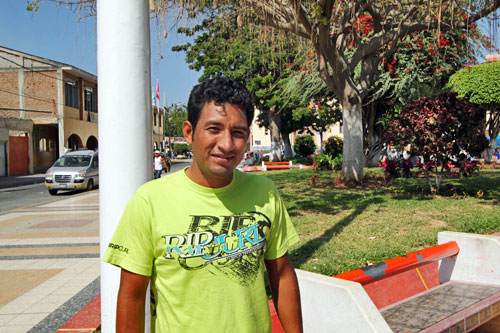
My guide Maikol, who handled the border crossing for $12

My guide Maikol, who handled the border crossing for $12

Maikol was wonderful! He met me in the Ecuadorian border town of Huaquillas and arranged for a taxi to take us to the Immigration office, where I got stamped out of Ecuador. Strangely, the Immigration office is three kilometers (1.8 miles) away from the border, so once I had been stamped out, he hailed a second taxi to carry us to the International Peace Bridge, which marks the border between Ecuador and Peru. We walked across the long bridge, weaving in and out of the heavy pedestrian traffic and fending off vendors hawking from booths that lined both sides of the long bridge. There was no doubt in my mind that pickpocket attempts and opportunistic crimes are common in this environment and I was doubly glad to have Maikol at my side.

At the end of the bridge I gratefully climbed into his car and we drove three kilometers to the Immigration office in Zarumilla, where I was stamped into Peru and got my 90-day visa on arrival. Again, I said a silent thanks for Maikol. Had I made the crossing alone, I would have been at the mercy of whomever I could find to drive me to Peruvian Immigration. With all the formalities completed. I hopped back into his car for the 27 kilometer (16 mile) trip to Tumbes.

Church on the central plaza in Tumbes, Peru

Church on the central plaza in Tumbes, Peru

As we drove south, Maikol explained how a government irrigation project had transformed the coastal plain from a giant sandbox into an agricultural Garden of Eden where fields of white and green asparagus stretched as far as the eye could see. Upon arriving in Tumbes, he helped me find an ATM where I could get Peruvian Soles, gave me a brief walking tour around the pretty central plaza, and then dropped me at the street corner where vans leave every 20 minutes for Máncora, my ultimate destination. For all this, he charged Continue reading

This entry is part 2 of 12 in the series Peru

I stepped out of my taxi and stood rooted to the ground in front of the train station. A tingle crawled from the bottom of my spine, goosebumps broke out on my arms and I blinked back the tears that threatened. Up to that point it hadn’t seemed real. Up to that point, it had been just a dream. But I was suddenly struck with the full force of reality: I was going to Machu Picchu. After all these years, this dream that had begun as a child was finally coming to fruition.

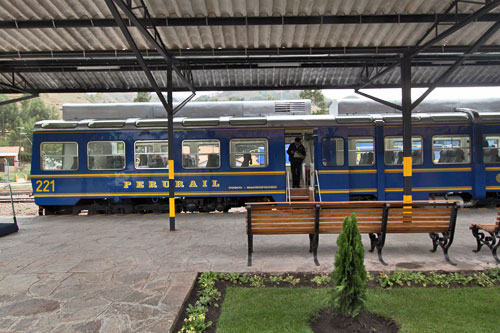
Peru Rail's Vistadome Service to Machu Picchu, Peru

Peru Rail's Vistadome Service to Machu Picchu, Peru

My mind was back in those childhood days as I walked across the glistening marble floors inside the station and peered at the bright blue train that awaited. I saw a young girl sitting cross-legged on the floor, leafing through the golden stacks of National Geographic Magazines, spellbound by photos of exotic cultures and distant lands. Little did I know that these images would be a driving force throughout my life, infecting me with a wanderlust for which the only cure was to go and see. And see I did. The elephants and lions of the Serengeti more than lived up to those images that had been seared into my brain, as did the wild horses of the Outer Banks in North Carolina. The Coliseum in Rome, Italy was every bit as exciting as I had imagined it would be.

Can’t view the above slideshow about the train ride to Machu Picchu, Peru? Click here.

The wail of the train’s whistle snapped me back to reality and once again I was overwhelmed with emotion. In less than 24 hours I would be gazing out over Machu Picchu, perhaps the most famous icon in the world for explorers. Would it also live up to my expectations? Given that I had arrived during the rainy season, would I even be able to see the view of the ruins made so famous by those National Geographic photos of yore? There was only one way to find out; I boarded the train and hoped for the best.

Gorgeous scenery in the Sacred Valley on the train to Machu Picchu, Peru

Gorgeous scenery in the Sacred Valley on the train to Machu Picchu, Peru

Gradually we descended from Cusco into the Sacred Valley, an ethereal landscape of jagged-toothed mountains heaved up around the latte-colored Urubamba River. Beyond Ollantaytambo we entered the magical realm of cloud forest, where eternal fog blankets the steep mountainsides and perpetual drizzle dampens everything. Rare spectacled bears roam the river banks and brilliantly hued tropical birds flit between orchid-strewn trees in this Shangri-la of eternal green. I hadn’t yet glimpsed Machu Picchu and already I was in awe. Continue reading

This entry is part 3 of 12 in the series Peru

I crossed a footbridge over a small tributary of the Vilcanota River and pierced an invisible veil. Leaving behind the sad little town of Machu Picchu Pueblo, devoid of trees and littered with broken down hostels and pizza pubs, I stepped onto the exquisite grounds of Inkaterra Machu Picchu Pueblo Hotel, where brilliant hummingbirds flitted between orchids and intertwining old-growth trees enfolded the hotel’s whitewashed stone villas.

Pool and villas at Inkaterra Machu Picchu Pueblo Hotel

Pool and villas at Inkaterra Machu Picchu Pueblo Hotel

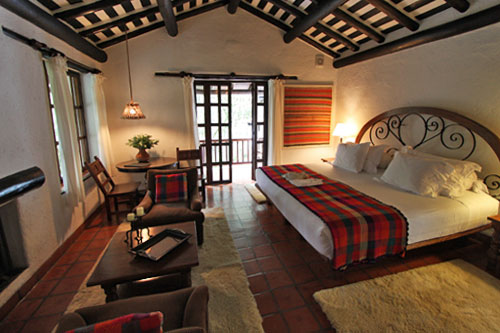
Soft light filtered through the cloud forest canopy as I followed the hotel’s representative along serpentine rock paths to my private casita. She threw open the rugged wooden door and stepped aside, revealing an enormous suite with luxury bath, fireplace, sitting area and private balcony. My gaze swept from the rustic wooden beams of the cathedral ceiling down to the king size bed. Salivating at the prospect of sinking into its mountain of pillows and 100% cotton sheets, I quickly thanked her and shut the door.

My gorgeous room at the Inkaterra overlooked lush gardens where tropical birds flitted

My gorgeous room at the Inkaterra overlooked lush gardens where tropical birds flitted

Barely had I unlaced my heavy boots and wriggled my toes when someone knocked at my door. “What now?” I wondered. “So sorry miss Barbara, but I thought you might like to see this.” She pointed to to the top of an old telephone next to my villa, where a gorgeous male Golden Olive Woodpecker rat-tat-tatted, determinedly searching for grub. “We don’t see them very often,” she explained, pointing out the female sitting on a nearby wire. It was the first of many kindnesses I experienced during my two days at this heavenly retreat.

Golden Olive Woodpecker showed up outside my cottage door to welcome me

Golden Olive Woodpecker showed up outside my cottage door to welcome me

I had learned about the Inkaterra when I received an invitation to a press conference in New York City, where Fodor’s would announce their Top 100 Hotel Awards for 2011. When I replied with regrets, explaining that I was currently traveling in South America, they responded with a list of the five South American properties included among the top 100 and inquired if I was planning to stay at any of them. Inkaterra Machu Picchu Pueblo Hotel was among those five. It was too much of a coincidence to ignore.

Because Fodor’s has long been considered a trusted authority on travel, especially with regard to accommodations, I knew the Inkaterra would be a treat, but I could not possibly have anticipated just how exceptional the hotel would be. Already impressed by the attentiveness of the staff, I returned to my spectacular suite and discovered a second surprise: on a table in the far corner a plate of gourmet chocolates and dried fruits awaited. Settling into a chair on my patio, I gorged on chocolate as I looked out over terra cotta roofs topped with ceramic bulls said to bring good fortune and gardens that quivered and twittered with rainbow-colored birds. An hour later, driven by a sugar high, I abandoned any thoughts of a nap and set out to explore. Continue reading

This entry is part 4 of 12 in the series Peru

The day I had dreamed about for much of my life – visiting the Lost City of the Incas – finally arrived. Twitching with excitement, I climbed out of bed and watched the cloud forest emerge from inky blackness, hoping for sunny skies. An hour later it was clear my wishes were not to be granted; the day dawned gray and rainy. Undaunted, I grabbed my umbrella and headed out to meet my private guide for the day, provided by the Inkaterra Machu Picchu Pueblo Hotel. Though I could have visited Machu Picchu on my own, for this once-in-a-lifetime experience I decided to splurge in order to learn as much as possible about one of the world’s most iconic archeological sites.

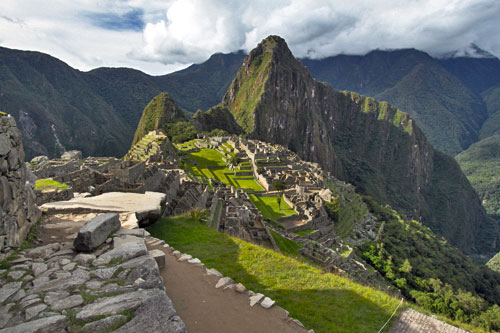
A 20-minute bus ride carried us up switchback dirt roads to the entrance, beyond which my guide turned left onto a stone staircase, bound for the top of Machu Picchu Peak. As we climbed ever higher, the famous mountaintop Citadel came into view; even shrouded in thick clouds it was a spectacular sight that took my breath away. At the top I stood next to the Guard House, the original entrance to Machu Picchu, gasping for breath in the 8,000 foot altitude and trying to grasp how and why this so called Lost City of the Incas was built. My first surprise came when I learned that Machu Picchu is not the fabled “Lost City.”

First look at Machu Picchu, shrouded in morning mists and drizzle

First look at Machu Picchu, shrouded in morning mists and drizzle

Though it was little known to the outside world prior to its rediscovery in 1911 by American historian Hiram Bingham, it has always been known to locals, most especially to the Quechua who are direct descendants of the Incas. Bingham had been searching for the city of Vilcabamba, the last Inca refuge during the Spanish conquest, when a Quechua family with whom he was staying told him about a nearby mountaintop ruin. Bingham paid the son, 11-year old Pablito Alvarez, about a dollar to lead him to the ruin we now know as Machu Picchu. Mistaking it for the Vilcabamba site for which he had been searching, Bingham dubbed it the Lost City of the Incas and the name stuck, even after the Vilcabamba ruins were recognized as the lost city and last refuge of the Incas. Eventually the government of Peru recognized the importance of Machu Picchu and took steps to protect it however, before they could actually create the sanctuary, they had to relocate indigenous Quechua living among the ruins. Years earlier, unaware that the ruins existed, the government had deeded the entire mountaintop to three local families.

Temple of the Sun, most important site at Machu Picchu

Temple of the Sun, most important site at Machu Picchu

From the top of Machu Picchu Peak I descended rain-slicked stone steps to the central ruins, marveling at monolithic granite stones so perfectly fitted together that not even a piece of paper will fit between them. My guide pointed out the difference in the masonry: painstakingly polished stones were used for religious structures, while rough-hewn stones signaled structures used by commoners. Though theories abound, most now believe that Machu Picchu was a religious center, occupied primarily by priests, members of the Royal family, and the commoners who served them. Three of the 140 structures found at the Citadel: the Sun Temple, The Temple of Three Windows, and the Temple of the Condor, seem to support this theory, but to me the most fascinating features of all were the monolithic stones carved to mimic the silhouette of the mountains on the opposite side of the valley and the Intihuatana, a behemoth rectangular rock with a sundial-like protrusion on top that is believed to have been designed as an astronomic clock or calendar.

Intihuatana, or Sun Dial, designed as an astronomical clock by the Incas

Intihuatana, or Sun Dial, designed as an astronomical clock by the Incas

At the Intihuatana, I watched visitors reach across guard ropes to “feel” the rock. My guide explained that many people believe the rock emanates a spiritual energy and that the Inca may have considered it a portal into other dimensions. I reached over the ropes and slowly scanned the rock until, at one specific point, I felt heat and a deep throbbing in the palm of my hand. “Do you feel something?” my guide asked, explaining that he had never been able to feel anything from the rock, despite his Quechua roots. I guided his hand to the spot where I had felt the energy and showed him how to scan back and forth until he found the “heat.” I watched the recognition dawn on his face. His eyebrows shot up and a surprised look told me he had finally tapped into the power. Continue reading

This entry is part 5 of 12 in the series Peru

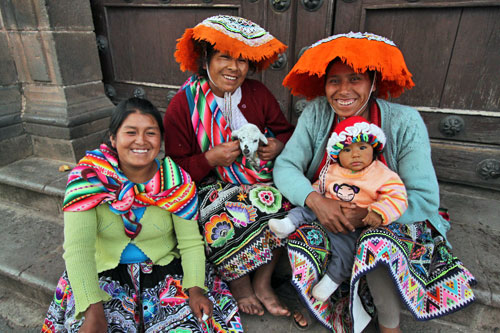
Three Quechua women sitting on the steps of the Qorikancha Inca Temple smiled broadly and motioned me over. They quickly arranged their vibrant traditional costumes and struck an adorable pose, complete with infant and baby lamb. “Cuanto?” I asked suspiciously. How much? “Lo que quieres,” they answered. Whatever you like. My instincts screamed “NO” but I snapped the photo anyway and held out a 5 Sole coin, the equivalent of about $2. One of the women snatched it out of my hand and secreted it within the folds of her garments. The other two held out their hands but I pantomimed that they should split it between themselves. Their smiles turned upside down. “What about the baby, something for him!” they pouted. “What happened to ‘Lo que quieres?‘” I grumbled, as the calculator in my head ground away, confirming that posing for ten photos per hour would earn them more than twice as much as I make writing.

Quechua women on steps of Santo Domingo Church in Cusco, Peru pose for photos

Quechua women on steps of Santo Domingo Church in Cusco, Peru pose for photos

This scenario was repeated often in Cusco, with variations on a theme. So called artists roamed the streets with oil and pastel drawings of Cusco’s picturesque narrow streets and Sacred Valley scenery. After the second one talked me into looking at his “portfolio” I realized the paintings were likely produced in a backroom by a handful of artists who crank out the same scenes over and over. Indigenous women strolled the cobblestone streets with lambs tucked under arms, always ready to pose for a fee, but those going about their daily business adroitly turned away from my lens. After three days in Cusco, I still knew little about local Quechua who are direct descendants of the ancient Inca civilization.

Temple of the Rainbow at Qorikancha, Cusco, Peru

Temple of the Rainbow at Qorikancha, Cusco, Peru

Temple of the Thunderbolt (Lightning) at Qorikancha, Cusco, Peru

Temple of the Thunderbolt (Lightning) at Qorikancha, Cusco, Peru

Hoping to learn more I stepped inside Qorikancha, the famed Sun Temple of Cusco, and hired a guide for a 40-minute tour of what may have been the most important temple in the Inca Empire. The complex originally consisted of the Sun, Moon, Stars, Thunderbolt (Lightning), and Rainbow Temples, with the Sun Temple being the most revered. All were constructed of dense gray volcanic rock, which was painstakingly carved into blocks with internal notches that fit together so perfectly that not even a sheet of paper could be inserted between the mortarless seams. The walls were built wider at the bottom than at the top, with doors and windows of a trapezoidal shape that provided strong support against earthquakes, and the entire building was roofed with thatch woven from a combination of wood and wild Andean bunch grass. By the time Quorikancha was completed in 1438, its floors, ceilings and walls were covered with gold plates, many of which were carved with images of deities, such as the representation of the Sun God with a round face surrounded by rays and flames that was so huge it covered all the front of the Sun Temple from wall to wall.

Notches carved into undersides of stones locked blocks together so tightly that not even a razor blade can be inserted between them

Notches carved into undersides of stones locked blocks together so tightly that not even a razor blade can be inserted between them

Golden panel at Qorikancha exhibits forces that the Incas worshiped: sun, moon, stars, rainbow, thunderbolt, jaguar, and water

Golden panel at Qorikancha exhibits forces that the Incas worshiped: sun, moon, stars, rainbow, thunderbolt, jaguar, and water

When Spanish Conquistadors captured the Inca leader Atahualpa and demanded a ransom in gold for his safe return, most of the gold was collected from Qorikancha. Ironically, Incas used the Spondylous shell, imported from the coasts of Ecuador, as their currency. Gold, silver, and copper were valued for religious and ceremonial purposes only. The Spaniards dealt a cultural and spiritual blow to the Incas when they melted down golden images of their gods into bars and coins for easy transport to Spain, which may have been more devastating than any economic measures they could have exercised. Continue reading

This entry is part 6 of 12 in the series Peru

Cusco was one of the highlights of my three months in Ecuador and Peru, but it took me a few days to ferret out the best things to see and do, as well as the best places to stay and eat, so I wanted to share what I discovered to help others who may be planning to travel to Cusco and visit the famed Machu Picchu Incan Ruins.


Where to stay

In order to provide a recommendation that would suit all budgets, I stayed at three different hotels/guest houses in Cusco:

Inkaterra La Casona Luxury Boutique Hotel:

Inkaterra La Casona is located in a colonial manor house that was one of the first Spanish constructions in the original Inca settlement and was at one time occupied by the conquistadors of Peru and their descendants. It is comprised of eleven suites surrounding a serene courtyard, just a short stroll from Plaza de Armas, Cusco’s present-day main square. From it’s luxuriously appointed common areas, which are furnished with overstuffed sofas and chairs, to its fabulous gourmet breakfast buffet, to its exquisitely appointed rooms, La Casona offers the top  of the line in luxury. Each room is equipped with high-count cotton sheets, feathered duvet covers, extra pillows, safe, mini bar, wireless internet connection and cordless phones, plus flat screen TV linked to cable TV, DVD and CD or I-Pod. The fireplace in my room was most welcome, as the nights in Cusco get chilly due to the 10,000+ foot altitude and most hotels do not offer heating of any kind. Rates for 2012 at $380 per night for a Patio Suite, $490 per night for at Balcony Suite, and $590 per night for a Plaza Suite. Rates include breakfast but do not include a 10% service charge and a local 18% tax (VAT) applicable to Peruvians and foreign residents in Peru. To make reservations, visit the online reservations page or call 800-442 5042 in the U.S. or Canada.

Sala at Inkaterra La Casona Boutique Hotel

Sala at Inkaterra La Casona Boutique Hotel

Courtyard at Inkaterra La Casona Boutique Hotel

Courtyard at Inkaterra La Casona Boutique Hotel

Bedroom suite at Inkaterra La Casona Boutique Hotel

Bedroom suite at Inkaterra La Casona Boutique Hotel

Luxurious bathroom at Inkaterra La Casona Boutique Hotel

Luxurious bathroom at Inkaterra La Casona Boutique Hotel

Posada In The Andes mid-range accommodations:

Posada en Los Andes was my choice for a mid-range hotel. Well-located just two blocks from the Plaza de Armas, this hotel offers rooms with cable TV and wifi and private ensuite modern bathrooms with 24-hour hot water. The manager, Yudy Aguilar Colpaert, was most helpful in recommending activities and local sites, to the point of providing even his private cell phone number, however he does not speak much English. Balconies in the rooms look over the city and breakfast is included in the room price. There is not heat in the hotel. Rates are: $35 per night for a single room, $50 per night for a twin or double room, and $60 for a triple room. To make reservations, fill out the form on their reservations web page or contact them at reservas@posadaenlosandes.com.

Hospedaje Turistico Recoleta budget accommodations:

Hospedaje Turistico Recoleta is a guest house in an historic building in a quiet area about a 10-minute walk from the Plaza de Armas, Cisco’s main square. They offer comfortable single, double, triple, and quadruple rooms with shared bath facilities, 24-hour hot water, and a large common room with ping pong table, TV, and a collection of videos. Breakfast is included in the room prices, which start at $10 per night. Although their website indicates they offer heating, I was not able to get a portable heater during my stay. For reservations call 84-231323 or 84-242954 (country code 51) or email info@hostelrecoletacusco.com.


Where to Eat

As a vegetarian, I had a bit of difficulty finding food in Cusco, until I’d spent some time there. Two of the best places, which serve both vegetarian and non-vegetarian selections, are listed below:

Don Mateo Picanteria:

Located across the street from Hospedaje Turistico Recoleta, Don Mateo Picanteria was an absolute find! Unlike most of the restaurants in Cusco, which are overpriced and cater to the tourist trade, this place serves mostly locals and thus is very affordable. The owner very kindly made me up samples of some of his best vegetarian plates to sample, including the incredible vegetable salad shown below. He also had the very best chicha morada, a drink made from purple corn that quickly became my favorite, in all of Peru. The modern interior design is warm and colorful and free wifi is available. The restaurant is located at Jr. Pumacahua 202-A in Urbanizacion Tahuantinsuyo, which is a 10-minute walk from Plaza de Armas. Telephone 84-232609 or email donmateorestaurant@hotmail.com.

Don Mateo Picanteria Restaurant

Don Mateo Picanteria Restaurant

Organic Vegetarian Salad at Don Mateo Picanteria

Organic Vegetarian Salad at Don Mateo Picanteria

Greens Restaurant:

Just around the corner from Plaza de Armas, on the street that runs between the Cathedral and the Compania Church, is Greens Restaurant. You’ll have to look carefully for the sign over a small door that leads to a hallway, where you climb to the second floor establishment. Upstairs you’ll find an open space with overhead beams, polished wooden floors, soothing music, and comfortable seating, either indoors or on the balcony, which overlooks part of the main square. Free wifi is a bonus. The menu offers an array of vegetarian entrees and salads, as well as many meat options. Most of the vegetables served by Greens come from their kitchen garden in the Sacred Valley or from small scale farmers who practice sustainable agriculture and raise pasture fed animals. The prices are higher that local restaurants, but not as high as most tourist places, and given the quality of the food here, the prices are quite reasonable. Open daily from noon to 9:30 p.m., located at Santa Catalina Angosta 135, second floor, phone 84-254753. Email: greens@cuscorestaurants.com.

Greens Restaurant in Cusco offers lots of vegetarian options

Greens Restaurant in Cusco offers lots of vegetarian options

Continue reading

12

Follow Hole in the Donut

Free Photography Ebook

Around the World with 40 Lonely Planet Bloggers
To download your free copy of "Around the World with 40 Lonely Planet Bloggers," subscribe to Hole In The Donut to receive emails about newly published articles and daily photos (three emails each week)
* = required field

Travel eBooks

Triposs.com

Triposs United States Popular Sights and Attractions

My Travel Itinerary

I'm currently in 

EasyToBook.com

DUBAI HOLIDAYS

Dubai
Holidays

FAVORITE TRAVEL COMPANIES

if you'd like to see the Great Wall, Forbidden City or Yangtze River, contact Beijing Impression. We offer tours in Beijing and other China cities.

Thomson Discount Codes

Punta Cana Hotels

Who Likes Us on Facebook

PROFESSIONAL AFFILIATIONS

EcoAdventure Media

North American Travel Journalist Association

Professional Travel Bloggers Assn.

International Travel Writers Assn.

AWARDS AND HONORS

Top Blogs

Holeinthedonut.com named one of the top 50 travel bloggers


Alltop, all the cool kids (and me)