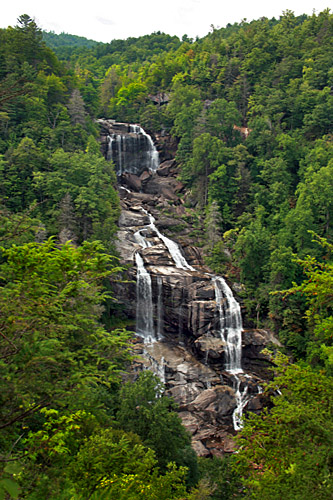
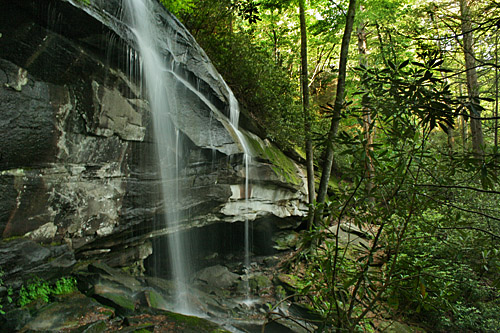
Plunging an amazing 411 feet, Upper Whitewater Falls in southwest North Carolina is the highest waterfall west of the Rockies. Located in a fairly rugged, little-visited area, the upper falls are easily accessible via a short paved path bordered by wildflowers, moss-covered boulders, and dense forest.

Upper Whitewater Falls in Sapphire, North Carolina

Tiny wildflowers border the path through dense forest

More wildflowers
After five weeks on the road it was time to head home, but not before one last day of hiking. From the North Carolina mountain town of Cashiers, I mapped a route past Gorges State Park, which opened to the public this past May. Located atop the Blue Ridge Escarpment, this newest North Carolina park is the source of five mountain streams that gradually descend toward the South Carolina border, where they suddenly plunge over spectacular falls and rush through steep-walled gorges.
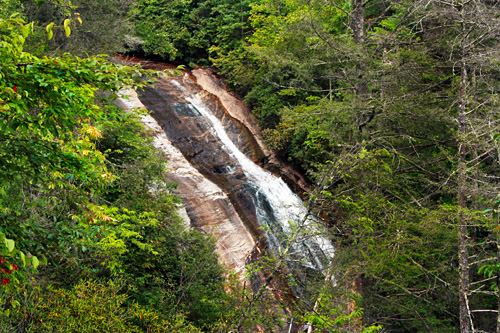
With only one afternoon at my disposal I decided on a duo of one-mile round-trip hikes. The first, marked “strenuous,” descended sharply to a wooden platform overhanging Bearwalow Creek, where Upper Bearwallow Falls dropped 200 feet into the gorge. Pretty – but a bit anticlimactic after others I have seen around Transylvania County. And almost not worth the straight-up, half-mile ascent that had me gasping for air.

Upper Bearwallow Falls in North Carolina's new Gorges State Park
After catching my breath I crossed the parking lot to access the “moderate” Bearwallow Valley Overlook trail. I eyeballed the spongy, leaf-littered path Read the rest of this entry »
Phony teepees, gold panning operations, and stores overflowing with “Indian” souvenirs stamped “Made in Taiwan” dominate the main street in Cherokee, North Carolina. On the sidewalks, performers with not a whit of Indian blood don garish costumes and perform steps bearing little resemblance to actual Cherokee ceremonial dance. In a shopping center parking lot, kids line up to ride a mechanical bull, while down the street, giant arrows direct tourists to a live bear display. Although located within the Reservation lands of the Eastern Band of the Cherokee Indians, it would be easy to dismiss the town of Cherokee as just another tourist trap and drive right on through. But don’t. Instead, turn at the Cherokee Museum and drive to the top of hill to Oconaluftee Indian Village, where an authentic Cherokee experience awaits.

Main highway running through Cherokee, North Carolina is strewn with touristy attractions and gift stores
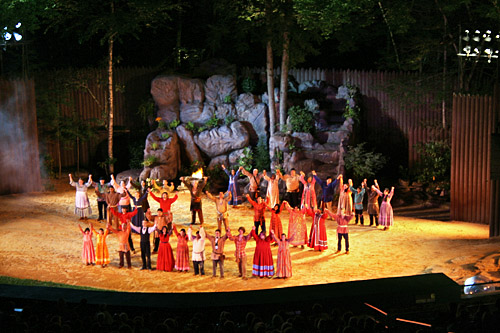
The Cherokees in Western North Carolina today descend from those who those who hid in the hills, defying removal during the infamous Trail of Tears mandated by President Andrew Jackson, and others who returned, many on foot. Gradually they created a sovereign nation of 100 square miles and, in 1948, established the Cherokee Historical Association to carry out their mission of preserving the history and culture of the Cherokee People. Oconaluftee Indian Village and its sister operation, the Unto These Hills Outdoor Drama are central to those efforts. Read the rest of this entry »
Deep within North Carolina’s Nantahala Forest, a glittering emerald valley is encircled by 5,000-foot high peaks. Sunshine streams down through crisp pine-scented air, illuminating the craggy stone faces of Yellow Mountain, Rock Mountain, and Chimney Top that stand sentinel around the valley. In the surrounding woods, spongy footpaths carpeted with last winter’s detritus follow rushing creeks to thundering waterfalls. Mountain roads snake past wildflower-choked fields, neatly manicured crimson barns, and tiny hamlets on their way to spectacular mountaintop vistas.
What is this mystical place? Have I been magically transported to Eden? No. This is Cashiers, North Carolina, as close to heaven as a mortal can hope to be.

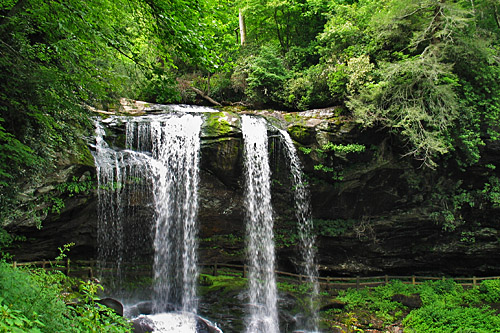
Path allows visitors to walk behind Dry Falls
This tiny town, located at the junction of U.S. Rt 64 and NC 107 in far southwest North Carolina, perches at the southern crest of the Blue Ridge Mountains. With little more than a mile of quaint shops and inns, the focus in Cashiers is on the outdoors. Visitors who are not physically inclined can explore the exquisite landscape with a ride on the Great Smoky Mountains Railroad. The 53-mile scenic rail journey crosses two tunnels and 25 bridges on its spectacular route Read the rest of this entry »
It’s not unusual for my travels to take on a theme. Past tours have found me checking out beaches, National Parks, botanical gardens, or historic landmarks. This trip became an unexpected search for waterfalls. It started simply enough. I wanted to do some extended hiking – one of my passions in life. The first trail I chose led to Hickory Nut Falls at Chimney Rock, North Carolina, which was running spectacularly due to the recent abundant rains. Realizing that this could be a once in a lifetime opportunity, I quickly decided to focus on discovering as many waterfalls as possible during this trip.
Serendipitously, my route led me to Brevard, North Carolina. Transylvania County, where Brevard is located, advertises itself as the “Land of Waterfalls” and claims to have some 450 cataracts within its boundaries. For four days I ferreted out waterfalls. Some were easily reached, being located just feet from the highway. Others required long hikes. A few could only be accessed by bushwacking a trail through the forest or climbing down rock faces. But it was worth the effort, because I captured amazing photos of spectacular waterfalls and mountain scenery.

Hooker Falls, DuPont State Forest, Brevard, North Carolina
On day one I began in the DuPont State Forest. Located in the Blue Ridge Mountains near Brevard, the site’s 10,400 acres of forest feature four major waterfalls on the Little River and several on the Grassy Creek. The original 7600 acre forest was established in 1996 through a generous bargain sale from the DuPont Corporation. The 2200 acre tract in the middle of the original State Forest, containing High Falls, Triple Falls, and Bridal Veil Falls was acquired by the State in 2000, after the State of North Carolina Council of State invoked its power of eminent domain. The action was taken against a real estate developer who was building a large residential housing development in the center of the Read the rest of this entry »
Although rain never puts a damper on my travels, sunny skies are usually preferable when I am on the road. There is, however, one exception; rain is a bonus when hunting waterfalls. Since I was in southwestern North Carolina for my annual real estate continuing education classes, I decided to hike to Hickory Nut Falls, located at the base of the 315-foot high granite monolith in Chimney Rock State Park.

Entrance to Chimney Rock State Park. Note the "chimney" on the left side of the mountain peak.

An elevator leads from the visitor's center to the top of Chimney Rock
I have always been intrigued by this solitary rock column protruding from the canyon floor. I wondered about the geologic forces that had formed it and the family that had painstakingly built a wooden walkway to the top. But it was reading about the elevator that had been blasted through 258 feet of solid rock in the center of the pinnacle that finally made me get in the car and drive to Chimney Rock Park back in 2006. Read the rest of this entry »
If the old wife’s tale is true – that an apple a day keeps the doctor away – folks in Hendersonville, North Carolina should be the healthiest in the state. North Carolina is the 7th largest apple-producing state in the nation and Henderson County is the largest apple-producing county in North Carolina. This was news to me. Although I lived in North Carolina for years and had passed through Hendersonville on occasion, I was unaware that apples were such an important part of the economy.

Downtown Hendersonville's cute Main Street
I am here quite by accident. Keeping my NC real estate license on active status requires me to take eight hours of continuing education each year. I chose to attend classes in Hendersonville because it is a day’s drive from Sarasota, Florida.

Giant apple decorates sidewalk in front of Hendersn County Courthouse
The classes were painful – eight hours trapped in a conference room with a hundred other agents who didn’t want to be there either – but once the disagreeable deed was done, I regained my sanity by investigating this lovely town, nestled in the heart of the Blue Ridge National Heritage Area at the southern end of the Smoky Mountains.
Shaking off the drudgery of the classes, I strolled the length of Hendersonville’s historic Main Street, enjoying this charming downtown that wanders up and down gently rolling hills, with views to the not-too-distant mountains. At the Henderson County Courthouse I paused to examine the curious giant hand-painted apple on the sidewalk. Soon I realized that these apple sculptures were scattered throughout downtown. This program of public art on display, appropriately named “A Slice of Hendersonville,†showcases apples decorated with images of bluegrass musicians, mountains, valley orchards, sheet music, maps, and even a scene from “Alice In Wonderland.” The local goldsmith Read the rest of this entry »
“Don’t be such a dingbatter,” my grandmother used to say to my sisters and me. Another of her favorites was: “go to the store that’s katty-whompus from your house and get yourselves some penny candy.” We knew what she meant. We grew up with these words. A dingbatter was a silly or foolish person. Katty-whompus meant across the street diagonally. But they weren’t words commonly used by our friends, or anyone else we knew, for that matter. So imagine my surprise when I wandered into the Ocracoke Preservation Society Museum and found those exact same words on an educational display!

Ocracoke Preservation Society Museum. Photo courtesy of www.ncbeaches.com.
Ocracoke Island, an isolated 16-mile long strip of sand that is home to only 800 residents, is perhaps the most fascinating destination on the Outer Banks of North Carolina. Historically a fishing and whaling village, this tiny island was so remote and isolated from the rest of civilization that native O’Cockers developed a unique manner of speaking.
The isolation of the island began changing a number of years ago when the State instituted a ferry service. Soon, tourists were flocking to Ocracoke and the old way of life began to disappear. Today there are only a few remaining O’Cockers who speak in the old brogue, and most of them refuse to speak to tourists. Indeed, when I lived on the Outer Banks, I frequently spent weekends on Ocracoke and often encountered O’Cockers who pretended to be deaf rather than speak to you. Fortunately, the O’Cocker language will be forever preserved through the efforts of the Ocracoke Museum. Read the rest of this entry »
Visitors to the Outer Banks are often fascinated by the history of piracy that surrounds these barrier islands. Bluebeard and Blackbeard both hid out along the Outer Banks and legends still abound about buried treasure that has never been discovered. These days, although stereotypical peg-leg, patch-eyed pirates no longer sail the seas off the North Carolina coast, every now and then something happens on these remote islands that makes us wonder whether pirates of old left more than buried treasure on these barrier islands.
Consider, for example the saga of the Gypsy Dane, a 50-foot, double-masted sailboat that got caught in the surf off Hatteras Island two weeks ago and washed ashore. True to their tradition, Outer Bankers rushed to the rescue. Owner of the boat, Yves R. Oger, of Toronto, Canada, was safely assisted from the distressed vessel by the U.S. Coast Guard, the National Park Service, and Hatteras Island Rescue Squad. Volunteers with the Avon Volunteer Fire Department cooked him dinner and allowed him to take a hot shower. One local business owner even let Oger use their Jeep, allowing him to sleep on the beach in front of his boat where he could keep an eye on it.
Because the boat was sitting upright and appeared to be undamaged, with only its keel buried in the sand, a marine towing service in Hatteras attempted to move the boat using a system of anchors and winches at high tide. When that didn’t work, they tried to turn the Read the rest of this entry »