Jane Addams, photo courtesy of University of Illinois
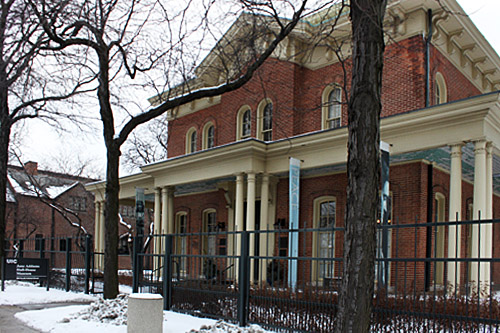
Jane Addams attracted national attention when, with with her friend Ellen G. Starr, she founded Chicago’s Hull House in 1889. The facility was located on the city’s near west side, in a densely urban neighborhood populated primarily by struggling immigrants. Modeled after the settlement houses in London, the mission of Hull House was to assist immigrants by providing a center for a civic and social life, improve the quality of education, and to investigate and improve the conditions in the industrial districts of Chicago.
Hull House provided kindergarten and day care facilities for the children of working mothers; an employment bureau; an art gallery; libraries; English and citizenship classes; and theater, music and art classes. By virtue of its efforts, the Illinois Legislature enacted protective legislation for women and children, setting the stage for passage of a Federal child labor law in 1916. As her notoriety grew, Addams was appointed to Chicago’s Board of Education, helped to found the Chicago School of Civics and Philanthropy, and led investigations on midwifery, narcotics consumption, milk supplies, and sanitary conditions in Chicago. Yet despite her laudable work, when Addams opposed the country’s entry into World War One, she was branded a traitor by the press and expelled from the Daughters of the American Revolution. Fortunately, history treated Addams with more respect; fourteen years later she was awarded the Nobel Peace Prize for her humanitarian work and pacifist ideals.

Jane Addams Hull House Museum historical landmark
Of the 13 buildings that once comprised the Hull House complex, only the original home and adjacent dining hall escaped the wrecking ball when a six square block area was razed to make way for the Read the rest of this entry »
After a few housebound weeks in Illinois’ sub-freezing winter weather, a thirty-six degree day felt positively balmy. Although the weatherman called for yet another dreary, overcast day, no snow or freezing rain was forecast, so I seized the opportunity to visit the Morton Arboretum, a 1,700-acre park in the Chicago’s western suburbs.

Walking along the shores of a frozen lake at the Morton Arboretum
The Arboretum was established in 1922 by Joy Morton, who is best known as founder of the Morton Salt Company. Although Morton’s head was in the salt business, thanks to his father, J. Sterling Morton, who founded Arbor Day and served as Secretary of Agriculture under President Grover Cleveland, the younger Morton’s heart belonged to trees. “Plant Trees” was the Morton’s family motto. And plant they did, over many years creating a horticultural showcase on their private estate. At the age of 65, Morton began developing the property into an Arboretum, with the mission to “collect and study trees, shrubs, and other plants from around the world, to display them across naturally beautiful landscapes for people to study and enjoy, and to learn how to grow them in ways that enhance our environment.” Read the rest of this entry »
They say all things come full circle. In September of 1969, I hopped aboard the Red Line of the EL and rode down the Dan Ryan Expressway for my first day at the University of Illinois at Chicago. The neighborhood around Roosevelt and Halstead Streets was not safe in those days. One block south was Maxwell Street, for years home to the world’s largest open-air market. By the time I arrived, foot traffic had been reduced to sullen gang members, panhandlers, and furtive drug dealers lurking in shadows between the neighborhood’s disintegrating, grime-covered buildings.

More than 50,000 bargain hunters descended upon Maxwell Street every Sunday during the heyday years
To the north, the university squatted across several blocks, a barren heap of concrete where saplings withered and stoned-out hippies lounged in the Student Union, strumming anti-war ballads on guitars. Barely seventeen at the time, it was more than I could handle; I dropped out before the end of the first semester, got a job, and never looked back. But last month, during my annual trip to visit my family over the holidays, I was invited to have lunch with a professor friend who teaches at the UIC. It had been more than 40 years since my last visit and I wasn’t sure I remembered how to get there, so I asked my Dad for directions.
“Halsted and Roosevelt? You mean down by Maxwell Street? You can’t go down there alone; it’s dangerous!”
I explained that, according to my friend, the neighborhood is now quite safe. Read the rest of this entry »
I am on my annual pilgrimage to the Chicago area to visit family over the holidays. The day after I arrived, freezing rain coated everything with ice, creating dangerously slick driving conditions. The following day, more freezing rain was followed by eight inches of snow. Since then, it has snowed almost every day and the temperature has barely climbed above ten degrees. Although I don’t venture out much in this kind of weather, I managed to brave the horrid conditions one rare sunny day to take photos. Frost and ice had coated the naked tree trunks and tall grasses, transforming barren forests into a fairyland. Despite my double-lined winter coat, knit cap, hood, boots and gloves, I just about froze to death. I swear the metal earpieces of my glasses froze to my cheekbones.

Winter fog coats the trees and obscures a country road

Beautiful ice-and frost-coated trees
I was feeling pretty proud of myself for enduring the elements until happening upon these teens jumping around on the rocks at the edge of the Illinois River, wearing only lightweight jackets, and I began to question whether I really was Read the rest of this entry »
With its rusting chain and flat tires, some consider the dilapidated, whitewashed bicycle chained to a sign post on Chicago’s north side a piece of urban junk. Cyclists know better. Pedaling by, they pay silent homage at this memorial to George Chavez, a cyclist killed at this spot in a hit-and-run accident in June of 2006.
The “ghost bike” memorial project began in 2003 in St. Louis, Missouri when Patrick Van Der Tuin, after witnessing a vehicle strike a bike rider, placed a white-painted bicycle on the spot with a hand-painted sign reading “Cyclist struck here.” Upon realizing that motorists tended to slow down when they passed the memorial, cyclists placed 15 more “ghost bikes” in spots around St. Louis where cyclists had been hit by automobiles. The idea caught on and before long there were ghost bikes in Pittsburgh, New York City, Seattle, Washington, D.C., Chicago, London, and dozens of other cities around the world.
Debate over whether the memorials should be temporary or permanent reached a zenith over a ghost bike in Washington, D.C.’s Dupont Circle. For more than a year, it stood just a few feet from the spot where a garbage truck struck down 22-year old Alice Swanson as she pedaled to Read the rest of this entry »
I am in the Chicagoland area, visiting my family as usual for the holidays. I love this city and would move back here in a heartbeat, but for its brutal winters (it has been hovering near zero for the last few nights, with daytime temps in the single digits). But the rest of the time, Chicago is a joy, and never has it been more joyful than this past September, when more than 20,000 people pulled off a massive surprise for an unsuspecting Oprah Winfrey during the Oprah Show’s 24th season kickoff party, held on Chicago’s Miracle Mile on North Michigan Avenue. The entire crowd performed a choreographed flash mob dance to the Black Eyed Peas’ “I Gotta Feeling.”
Oprah, who was obviously shocked and thrilled by the surprise, showed the video from that event on today’s show and interviewed two of the people who were dancers. One said that her favorite part of the dance was when everyone was hunched over with their hands on the backs of the person in front of them. Amazed no one seemed to care that they were being touched by total strangers and elbowed by dancers aside them, the woman speculated there would be world peace if everyone lived with that kind of spirit and happiness. Another participant said that he still remembers the steps and whenever he is havingh a bad day, he closes the door to his office and dances to the video of the event. He described the portion of the dance where participants put their palms together in prayer fashion and raised their arms to the sky as “Joy Rising.” I watched the video three times and got goosebumps each time. Take a look:
My wish for everyone in 2010 is “Joy Rising.”

Metal angel sculptures line pathways in wildflower choked Northerly Island, previous home of Meigs Field. The old runway, now a mowed grassy strip, is still visible in the background.
During my recent trip to Chicago, I took an afternoon stroll around Northerly Island, located just behind the downtown Museum Campus on the lakefront. This narrow peninsula was once home to Meigs Field, a tiny airport that opened on December 10, 1948 and by 1955 was the busiest single-strip airfield in the country. In its latter years, the airfield served mostly private planes, but I have a vivid recollection of landing at Meigs in a prop engine puddle-jumper many years ago, so commercial airlines must have used the field at one time. Landing and taking off from Meigs Field was a scary proposition. The runway was short and dead-ended into Lake Michigan; my first landing was my last – purposely. I was certain my plane was going into the drink.
In 1994, Chicago’s Mayor Daley announced plans to close the airport and build a park in its place. Nine years of legal battles ensued until, in a controversial move on March 30, 2003, the Mayor ordered private crews to destroy the runway in the middle of the night, bulldozing large X-shaped gouges into the runway surface. Daley subsequently excused his actions, insisting that post-9/11 risks of terrorist-controlled aircraft attacking the downtown waterfront necessitated the closing of Meigs Field.

Closeup of sculpture on Northerly Island
These days, Northerly Island is strewn with wildflowers. Metallic angel sculptures rise amidst blossoms, pointing the way down narrow asphalt paths winding between the Adler Planetarium and the old air tower. Butterflies drift from bloom to bloom and songbirds warble melodies from nests secreted in tall grasses. Eerily, concrete runway markers – the only remnant of the once busy airfield – poke their heads above thick vegetation growing on the old landing strip. Walking through this idyllic park, it is hard to imagine that it may soon undergo yet another radical transformation. Read the rest of this entry »
The meaning of the term “skyscraper” has changed dramatically over the centuries. Originally a nautical term referring to a tall mast or main sail on a sailing ship, the word was first used to describe buildings when the ten-story steel-framed Home Insurance Building was constructed in Chicago in 1885. Although later demolished, the structure forever marked Chicago as the birthplace of the skyscraper. Chicago today has an unrivaled collection of skyscrapers that makes the city a premiere destination in the world for the study of architecture.

Chicago Model City display in the lobby of the Architecture Foundation documents the history of architecture in the city
Chief among the city’s spectacular skyscrapers is the Chicago Board of Trade Building, which anchors the southern end of the downtown financial district on LaSalle Street and is the world’s oldest futures and options exchange. Built to provide a centralized location where buyers and sellers could meet, negotiate, and enter into contracts to buy and sell commodities produced in the Midwest, farmers flocked to the CBOT with samples of their wheat, corn, and soybean crops. Over time, the function of the exchange evolved into one of buying and selling forward contracts for commodities. Today, more than 50 different options and futures contracts are traded by over 3,600 CBOT members through open outcry and eTrading from the floor of the open exchange.

Art deco designed Chicago Board of Trade Building anchors the south end of the LaSalle Street financial district
Growing up in Chicago, I had always wanted to tour the Board of Trade building and watch the commodity traders in the “pit” but, like most locals who never visit the attractions in their own back yard, I just never got around to it. I moved away and forgot about CBOT until recently, when I returned to the city for a conference scheduled to be held in the Loop. In years past, anyone could visit the Chicago Board of Trade, but since 9/11, security concerns have necessitated limiting access to the facility. Fortunately, tours are still available through the Chicago Architecture Foundation, a nonprofit organization dedicated to advancing public interest and education in architecture and design. The CBOT is one of 16 “Lunchtime Tours” of historic buildings available through the Foundation. In this instance, the timing was perfect; not only would I learn the history of the skyscraper and see its unique architectural details up close, at the conclusion of the tour I would have an opportunity to witness live commodities trading in the pit from an overhead observation gallery.
I arrived early and strolled around the massive granite tower to kill time. Courtyards on two sides of the building provided seating for harried traders clad in the bright blue, red, or gold jackets of their particular brokerage houses. They rushed in and out of revolving doors for quick breaks, gulping coffee while talking on cell phones and puffing furiously on cigarettes, generating a billowing cloud of smoke. Wading through the billowing smoke, I was reminded that not so long ago I was living the same kind of harried and stressed-out life and I gave silent thanks that this part of my life is over. Read the rest of this entry »
Step inside a mall in San Diego and you might just as easily be walking through a Philadelphia shopping center. Likewise, many cities around the country are so similar that I often have to stop and remind myself where I am. But every once in a while I visit a city that stands out from the rest, a city that has a powerful personality. Chicago is one such city.

Chicago Skyline from the Adler Planetarium
With each visit, I have become more impressed by this awesome city. But during my most recent visit I began to wonder, “What makes this town so special? What defines its powerful personality? How has Chicago succeeded in distinguishing itself from the faceless masses of other large cities across this country?” Certainly its extensive cultural opportunities, diverse ethnicity, and unique architecture are all factors to consider. But many of these same elements are found in other cities. For an answer, I had to dig into Chicago’s history. Read the rest of this entry »