It all began with “CowParade,” a public art display of giant fiberglass cows hosted by the City of Zurich, Switzerland in 1998. Decorated by local artists and then displayed all over the city, the sculptures were ultimately auctioned off to benefit charity. The event was so successful and well-received that it became the impetus for iconic public art displays all over the world.

Lone remainder of Chicago's CowParade, this bronze casting sits outside the Chicago Cultural Center

Sarasota clown sculpture
Chicago was the first to mimic the concept; in a nod to its history as a meat packing center, fiberglass cows were scattered throughout the Loop in 1999. Since then, scores of copy-cat events around the world have featured sculptures of whatever animal or item best represents the sponsoring city.
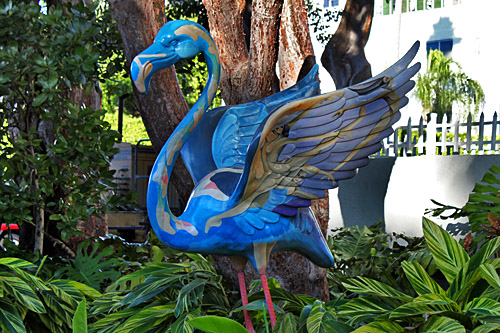
Sarasota, Florida, also known as Circus Capital of the World, chose clowns. The Outer Banks of North Carolina, during the centennial celebration of Wilbur and Orville Wright’s first motorized flight, attached metal wings to mustangs, merging “First Flight” with its reputation as home to one of the largest herds of Spanish mustangs still remaining in the wild. And in Miami’s South Beach, five-foot tall flamingos still peek from gardens and line the broad boulevards. The list goes on: Los Angeles sponsored angels; Hendersonville, North Carolina exhibited giant apples; and Norfolk, Virginia had mermaids. Read the rest of this entry »
If you look hard enough, you can pierce the phony facade in even the most tourist-choked destinations. In Miami Beach I finally broke through the barrier when I connected with its artist community.
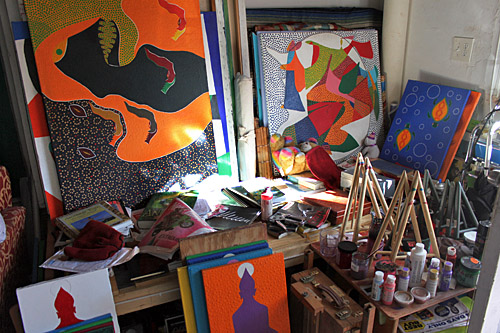
My first view of the art of Karim Ghidinelli was from a second floor balcony at the Art Center/South Florida, looking down into his open cubicle. The artist sat in the center of the room, hunched over a cell phone, surrounded by massive oil on tin paintings. Initially, the flamboyant colors splayed across each piece held my attention. But I was even more fascinated when I realized that a giant thumbprint had been etched into the center of each metal canvas. I had to see them up close.

Ghidinelli in his studio, surrounded by huge canvases
The intense young man welcomed me into his studio and studied me with dark, brooding eyes as I examined his paintings up close. Each fingerprint whorl was formed by words, some readable and some not, spiraling in toward the center. I read snatches:
“…the most natural pressure is fear…”
“…all the traits that make the self do not come from the self so how do we claim…”
“…fall under the omnipresent post-modern theory of everything…”
“…fearless encounter…”

The artist's intensity is reflected in his workk
I asked Ghidinelli if the concept of fear was central to his work. “We all strive for stability but never achieve it,” he explained. Ghidinelli is no stranger to this struggle; like most artists he never knows when Read the rest of this entry »
The young Latina leaned against the door jamb, disinterestedly watching tourists stream past. Her four-inch stilettos, strapless bustier, and leather hotpants suggested the oldest profession on earth, yet she stood in the doorway of a family-owned bodega where Ybor City’s residents gather each day to sip strong espresso, share gossip, and slam dominoes. Unlike Miami Beach, where I was disappointed by the lack of Latin flavor, Ybor City is the real deal: an historic Cuban district in Florida’s Tampa Bay area.

A lady of the night or just waiting for the party to start?
Some years ago I had lunched at Ybor City’s Columbia Restaurant, famous for their authentic Spanish cuisine. In the light of day, empty storefronts, peeling paint, and wind-blown trash suggested despair and decay. I checked the neighborhood off my list of places to see, never intending to return. But as fate would have it, I was unexpectedly detained in Tampa this past Halloween eve. As the last rays of daylight slowly faded I searched for a hotel along unfamiliar streets and suddenly found myself in Ybor City.
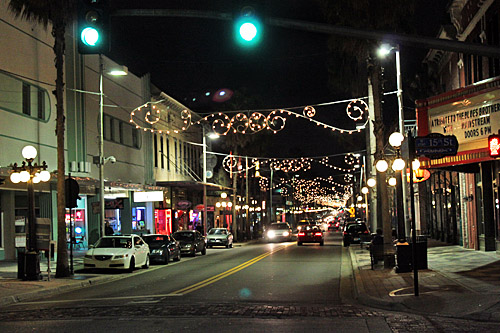
This was not the Ybor City I remembered! Curvy metal trellises decorated with white lights arched over the main street as far as I could see. Vivid neon signs threw reflections into the street and the aroma of strong coffee mingled with rich Cuban cigar smoke. Under cover of darkness, neglect melted away, replaced by pools of golden light spilling from bars and cafes and throbbing Latin beats. Buildings that had once seemed dilapidated suddenly oozed charm.
Ybor City owes its existence to the cigar industry. In 1884, Henry B. Plant completed his railroad to Tampa and was in the process of improving the port facilities at Port Tampa. Realizing that Cuban leaf tobacco, the best in the world, and the finished tobacco products could easily be imported and exported, Vicente Martinez Ybor founded Ybor City as a cigar manufacturing center in 1886. He quickly attracted experienced cigar workers from Spain, Cuba and Italy, establishing Tampa as the “Cigar Capital of the World.”

Ybor City at night is a fun cultural travel destination
Life in those early years revolved around social clubs that were organized to serve specific ethnic groups (L’unione Italiana for Italians, El Circulo Cubano for Cubans, Club Marti-Maceo for Afro-Cubans, among others). Not only did these clubs preserve the cultural heritage from one generation to the next, members could also subscribe Read the rest of this entry »
Most of the time I arrive at a destination without preconceived notions, but Miami Beach was steeped in expectation. Thanks to the popular TV show, CSI Miami, I imagined exquisitely preserved art deco architecture, tropical weather, oiled body-builders with rippling muscles, exuberant Latin culture, and colors vivid enough to make your eyeballs hurt. It was none of those things.

Palette of pastel colors adorn Miami Beach's famoous art deco architecture
Just my luck, when I finally had an opportunity to visit Miami Beach, the temperatures plunged into the low 50′s. I was not the only one unprepared; tourists everywhere shivered in shorts and sleeveless tops. Even the Holiday Inn Oceanfront, where I won a free night’s stay in a contest held by Travel Wonders of the World blog, had a hard time coping. Housekeeping had set my room’s thermostat at 50 degrees and it was ice cold. Even turning up the thermostat had little effect. Since south Florida temperatures are normally much higher, the hotel has both “room air” and “facility air;” the room air could be turned off but the facility air could not. It took a portable heater and extra blankets – which the hotel graciously delivered – to remedy the problem.
The frigid weather also nixed my plans to lie on the beach, although plenty of souls heartier than me ventured out in the middle of the afternoon, when temps soared to the high 60′s. Not to be deterred, I put on my warmest available clothes and walked along the oceanfront, searching for the Miami Beach I envisioned. Rather than long legged, exotic women in skimpy bikinis I found families; instead of sugary Read the rest of this entry »
I’m celebrating an anniversary of sorts. Three years ago this month I walked away from corporate life to pursue my lifelong passions of travel, writing and photography. Although it’s not an easy path, I feel alive for the first time in my life. The serious perspective that dogged my every thought and action for years has magically vanished. The difference between then and now was driven home recently during when I experienced Walt Disney World with uninhibited, childlike joy.
Here’s to many more years of joy!

Pyramid of 200 painted bowling balls are stacked in the front yard of "Whimzy," home of artists Todd Ramquist and Kiaralinda
Everywhere I went in the small village of Safety Harbor, Florida, people told me the same thing: “You have to see the bowling ball house.” It was easy to find, but even without directions it would have been hard to miss the pyramid of 200 bowling balls stacked on the front lawn. Fascinated, I walked around the corner lot. Crazy quilt pathways of multi-colored ceramic tiles wound through grounds where bowling balls lined garden beds, balanced on pillars, and peeked out from beneath jungle vegetation. Even the mailbox sat on a stack of bowling balls.
A creation of husband and wife artists Todd Ramquist and Kiaralinda, “Whimzey” began when Kiaralinda saw a single bowling ball decorating the cactus garden in front of a house. “I thought it was a neat idea, but I wanted more.” Not long afterward, she spotted a rack of bowling balls at a flea market. “The sign said: ’10 free bowling balls per person.’ In those days we were driving some little car that could barely fit two people, but we crammed it with 40 free bowling balls.”
When Todd and Kiaralinda set up an outdoor table and began painting the balls, neighbors wandered over to see what was going on. “Kids started asking if they cold paint a bowling ball, so we gave them all brushes and let them go,” said Todd. Before long, people began dropping off old bowling balls to be used in the design. Wondering what to do with the surplus, they invited artist friends to paint a bowling ball. To their surprise, many accepted the offer; these creations, affectionately dubbed the Read the rest of this entry »
When Dr. Robert Andrews first proposed that a series of historically accurate, educational murals be painted on downtown buildings in Punta Gorda, Florida, some residents opposed the idea, insisting the murals would be nothing more than “graffiti.” Business leaders, on the other hand, loved the idea. They formed the Punta Gorda Historic Mural Society (PGHMS) in 1994 and successfully lobbied the City Council for permission to paint the first one on a large blank wall of a former shopping center located on U.S. 41 Northbound. Once the first mural was completed, others quickly followed, and residents who had initially opposed the idea began taking guests around town, proudly showing off the works of art.

Cattle Drive Down Marion Ave, 1903
Over the next ten years, more than 90 murals were painted at 20 different sites. Then disaster struck. On Friday, August 13, 2004, Hurricane Charley roared onshore at Punta Gorda as a category 4 storm with sustained winds in excess of 145 miles per hour (to get a sense of the destruction, check out this post on the TampaBay.com blog; click on each photo to see the same scene, as it looked immediately following the hurricane). In one short hour, 11,000 of the city’s 16,000 homes were totally destroyed, along with six schools and six fire stations. About 300 businesses were leveled. And half of the mural sites were gone.

FEMA Photo
Five years later, the occasional vacant lot is still visible, but buildings that were damaged beyond repair have been torn down and debris has been carted away. In their place, new facilities have sprouted. Downtown has colorful new shops, luxury hotels, and a new convention center. Schools and fire stations were rebuilt with state-of-the-art facilities. The murals, too, are slowly being recreated. Read the rest of this entry »
Although I don’t pretend to understand the surreal images of distorted females and melting clocks that pervade the art of Salvador Dali, his work had always intrigued me. I simply assumed the symbolism was an unknowable product of a demented mind. So I was surprised when the docent at the Salvador Dali Museum in St. Petersburg, Florida commented, “Luckily, Dali spoke and wrote voluminously about the meaning of his artwork while he was alive, thus we understand what each piece is meant to represent.”
Fascinated, I followed the docent around the gallery as she related the history behind each piece and explained what the artist was trying to convey in his bizarre landscapes. With its 96 oils created between 1917-1970, the Salvador Dalí Museum is the permanent home of the world’s most comprehensive collection of the renowned Spanish artist’s work, including the Impressionist and Cubist styles of his early period, abstract work from his transition to Surrealism, the famous surrealist canvases for which he is best known, and examples of his preoccupation with religion and science during his classic period.
The tour ended at a sunken gallery where half a dozen of Dali’s enormous religious canvases hung. At the suggestion of our guide, we stood above and looked down on these floor-to-ceiling pieces in order to have a wider view. This was a different Dali – one that I had never experienced. “Look closely – what do you see?” our guide asked, gesturing toward the oil titled, “Halucinogenic Toreador.”

"Halucinogenic Toreador" - What do you see in the painting?
I’d spotted the most obvious of the double images even before she asked, but was astonished when she began pointing out dozens of double images secreted throughout the painting. Almost everyone in the room could see the two male toreadors emerging from the two main Venus de Milo statues. Most could discern the Dalmatian dog hidden at the bottom of the painting and the head of the slain bull, with its pool of blood represented as a blue lagoon. But I had to get up close to see the smaller hidden images. The panting is littered with Venus de Milo statues and each one, no matter how tiny, contains the hidden image of a toreador’s face.
Sarasota’s split personality has always intrigued me. As a retirement community, the average age of its residents is well above the national average and even significantly above the Florida average. On the other hand, several universities and community colleges located in Sarasota County, including the renowned Ringling College of Art and Design, infuse the community with vibrant, creative young people. This youthful energy translates into quirky fashion; unique art; and always, music, music, music.
Most any day of the week I can find live music in downtown Sarasota, but my favorite event is open mic night every Wednesday from 7 to 10 p.m. at Pastry Art on Main. Some weeks feature fiddlers and dobro players; other times, acoustic guitars dominate. Last week, the organizers of this free event, David Brain and Carmela Pedicini (a fabulous musician and vocalist known locally as “Radio-Free-Carmela) outdid themselves. They spread the word that Comcast would be on hand to film the event for their on-demand channel and local talent flocked to the cafe like never before.
For nearly four hours I sipped Americano coffee and nibbled ginger shortbread cookies while a remarkable lineup of artists performed original folk, blues, rock, and indie material. Long-time favorites Michael Read the rest of this entry »