
I stood on the stairway leading to the Buddhist Monastery in the Himalayan town of Marpha, holding onto the railing for dear life as as gale force gusts shredded the gauzy Tibetan prayer flags cascading down from the hilltop. Like every other day in Nepal‘s Lower Mustang Valley, ferocious winds had begun roaring down from the mountaintops in mid-morning and would continue until early evening. Struggling to keep from being blown over, I perused the tiny village that spread beneath me.
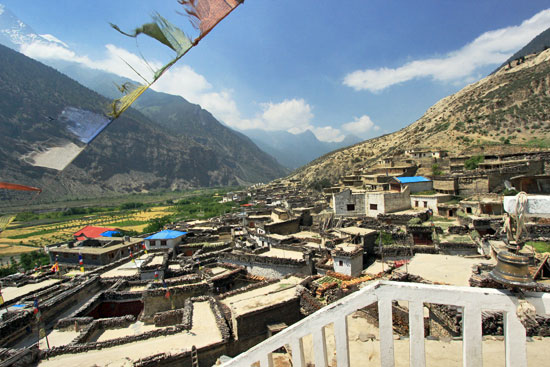
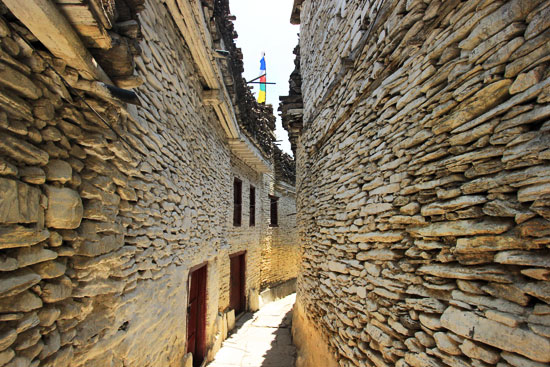
Marpha is notable for it’s many-storied old stone houses, built by hand without benefit of mud or mortar, and for the delicious apples grown in the lush valley that snakes between the Nilgiri and Dahlugiri Himalayan ranges. While I found those facts intriguing, what most caught my attention were the stacks of split firewood that lined the edges of the flat roofs of every home in town.
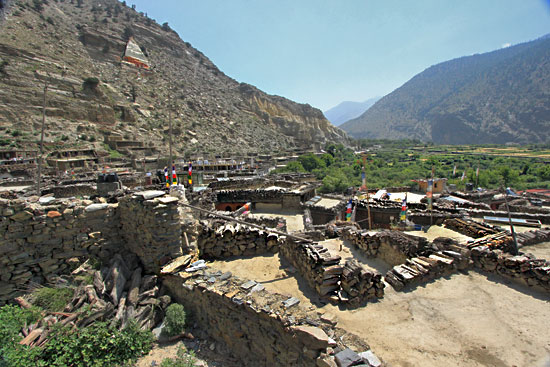
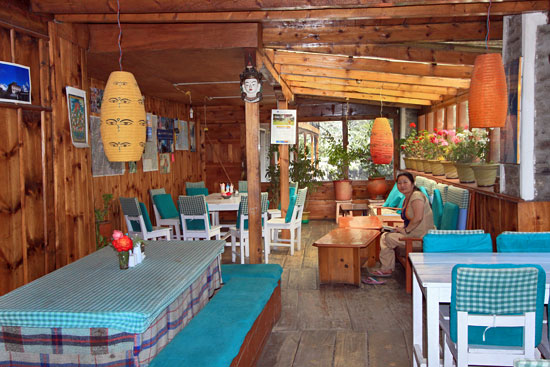
Later that same day I was sitting in the common area of the Neeru Guest House with the owner, Kamala, when I glanced up and noticed soaring piles of firewood lining the hotel’s roof. “It must get really cold here during the winter if you need that much firewood,” I said. “It does get cold, but we never use the firewood,” Kamala replied. “Most people move down into the Pokhara Valley for the two coldest months of the year. But we keep the wood for several reasons. First, it’s a decoration for our flat roofs. But more importantly, having a lot of wood on your roof means you are wealthy. We’ve never touched our wood – there are logs up there that were cut by my father and grandfather.”
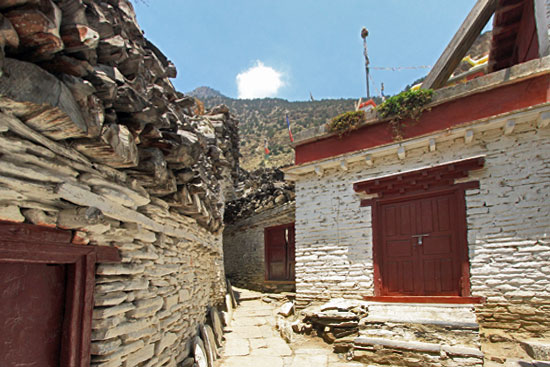
In a desolate landscape barren of trees with the exception of the apples trees that have been planted along the river banks in recent times, it made a great deal of sense that wood equaled wealth. But while the commodity that implies wealth in Marpha is different from what defines wealth in the U.S., the human need for security and personal status are surprisingly similar.

Hello Ms. Weibel and Mr. Mukanda,
I love Nepal and want to arrange a group trekking to Muktinath. We plan to stop at Marpha Village for a while and do something good for the people there. But I do not know the situation there. Is there any something we can do for the people? Or maybe for any village around there ot along the trek to Muktinath?
Thanks so much fro the nice write and picture Ms. Weibel…
Warm Regards,
Yanti
Sorry Yanti, but I really have no suggestions for you. It’s been a number of years since I was there and have no connections there.
I visited Marpha with My guru, Lowa Tulku Singey Rinpoche several years ago. He is from that monestary and mow lives in Colorado in the Inited States. The Thakali people were wonderful hosts as was Gelung Mala, who ran the monestary.
I noticed an abundance of Apricots, but did not see apple orchards.
Marpha village has a rich and unique history. If you have questions perhaps I can find a contact for you.
Best Regards,
Kathryn
[email protected]
Marfa looks amazing but I have been told food is astronomically expensive. Is that right.
Thanks Maree
Hi Maree: It’s been a few years since I was there, but I don;t recall that the food was at all expensive. It would surprise me if that was the case.
Dear Weibel, thank you for nice informative write-up. Recently, I visited Marpha village and had a chance to spent some time around the Monastery and felt ‘inner peace’. I found the village neat and clean and full of lodging and food facilities. My purpose of the visit was to conduct research on ‘customary dispute settlement practices of Thakali community’ . Thank you Weibel, again.
Rajendra
You’re very welcome Rajendra. Happy my story helped you in some way.
do they have toilet facilities in their houses ?
It is like anywhere else in Nepal. The more wealthy have squat toilets in their homes, but most of the poorer residents have outhouses with squat toilets that are detached from their houses.
i need contact of mustang apple proudce farmers
I am a native of Mustang. I know many peoples who grow apple. You can email me if you need contact of some apple farmer.
I need some data about apple production in Mustang, it’s potential, data on Marpha (apple wine) if you could provide some. Thank you!!!
Sorry Ram, but I do not have access to that information.
can u give me your email id…i am an architect…and i need to know about lifestyle of people of marpha
Hi Sargam: I really cannot offer you any more information than what was in my article, as I was only there for a few short days.
[email protected] would be waiting for your informative reply of mustang and marpha’s apple farming !!
thank you !
Who would’ve thought that wood equals wealth. What an interesting article that provides insight into the lives of these people in Marpha. And I love that 3rd picture of the old stone houses! 🙂
Hi Wan: The homes in Marpha were nothing short of startling. In some cases, the walls went up three stories, with absolutely no grout between the stones. I constantly marveled over how they stood upright, but they’ve been standing for centuries!
What an interesting read! I never would of known this about the wood had I glanced upon it myself! It is funny how we all really are the same around the world in terms of needing certain things like you mentioned personal status and security!
How interesting. This is a part of the country that I would love to visit next time I am there.
If they still have wood from their grandfather, then I’d suggest they have a better idea of saving than most modern day westerners.
If the landscape is barren of trees, where does the firewood come from? What an interesting glimpse into Nepalese culture.
Donna: I hadn’t thought about that, but it does perhaps explain why wood is seen as having such great value.
Hi Donna Hull and baweibel,
I am a native of Mustang. Though the land is mostly barren, the lower Mustang has more forest. We still depend on firewood as our main source of energy. As far as wealth is concerned the woods that are kept in the roofs for decoration is a special kind of wood that is relatively harder to find and it has good odor.
This is just so beautiful. I just love the Himalayas!!
I think it’s fascintating. And to think they have wood from their father and grandfather.. it’s speak more than just wealth I think. Great story.