
After two weeks in the Adirondacks of upstate New York I began to learn more about the culture of the area. Though the Adirondack Mountains are ancient, the human history within them is relatively young. It is unusual to meet second generation residents and third generation families are a rarity, so it was a privilege to meet Judy Damkoehler, a descendant of the men who built the Irondequoit Inn. “My great-grandfather and great-uncle Herbert first saw the Adirondacks in 1877. To celebrate Bert’s graduation from high school in New Jersey, they decided to walk to Montreal to visit my great-great-grandmother. Bert went on to college and married, but he never forgot this area.” When Bert finally convinced his buddies to visit the area they were so smitten that they immediately began buying up land. The present-day Lodge and Annex of Irondequoit Inn – originally old farmhouses in the village of Piseco Lake – were dragged up to the site on rollers by a team of oxen. Soon, the partners were welcoming guests and selling shares in the property. One hundred and twenty years later, many shares are still owned by descendants of the original investors.
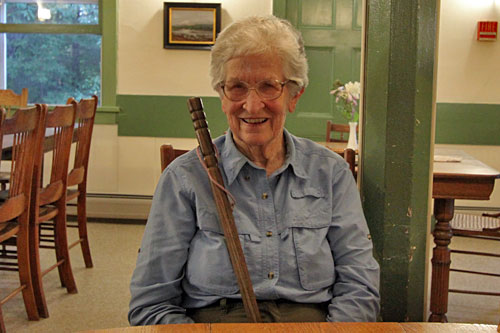
Damkoehler first came to the Inn in 1930 at the age of three. Piseco was an unincorporated rough and tumble lumbering town, full of bars and raucous men. “There was no electricity in those days and we ate fried sneaker soles for dinner – probably illegal venison,” she grinned. “By the time I was 10 or 11 I was allowed take the rowboat out on the lake alone.” During the Depression years she worked at the Inn. “We called ourselves ‘slaves’ and lived in the ‘slaves quarters’ (the annex). We waited tables, washed dishes, cleaned rooms…and met boys.” Damkoehler has traveled to South America, Iceland and Europe but her favorite place in the world is still Piseco Lake. “It gets in your blood,” she insists, adding that the next generation – her cousins – are now coming to the Inn every summer.
Everywhere I went in the Adirondack Mountains I met people living close to the land. At the Adirondack Museum Caleb Davis was sponsoring a paddle-making workshop. Caleb made his first paddle by hand at the age of 11 and has run a paddle-making business each summer for the past 22 years. While it’s great fun, paddle making is also hard work; participants on the day I visited had sore arms and aching shoulders from working with wood planes and files. So why do they do it? “Making something themselves – I think that’s the thing people are missing more and more nowadays. It’s about being connected; working with your hands, your eyes…feeling things,” says Caleb. Certainly, that was motivation for Brian and Leia Johnson. “We’ve just gotten into paddling and we thought it would be kind of cool to have our own paddles. It’s a sense of pride to be able to say, ‘This is the one I made and I’m going to use it.’”
At Great Camp Sagamore, I found artisan David Woodward in the original blacksmith shop that served the Vanderbilt family back in the late 1800’s and early 1900’s. In his long leather apron and protective ear muffs, he stoked the furnace to a temperature of 3,000 degrees, pulled a red-hot metal wedge out of the fire, and pounded it with a ball peen hammer to demonstrate the rustic ornamental ironwork that the rich owners of the camps coveted. Woodward, who attended the Brotman Forge Blacksmith School in Vermont, has turned his fascination with the art of blacksmithing into a successful career. When he’s not demonstrating at Sagamore, he is in his studio, Train Brook Forge, where he creates intricately detailed metal implements ranging from fireplace screens to cooking utensils.
Back at Irondequoit Inn for dinner, I was mulling over the unique ways in which Adirondackers had carved out existences in this challenging corner of the world when I turned over the Inn’s dinner menu and read the following:
“All our meals are cooked to order and made from the best ingredients we can locate as locally as possible. Many of our ingredients are organic, pesticide, hormone and antibiotic free. We are proud to feature eggs and meat from local farmers. Most of our preservative-free artisan bread is made in Herkimer County by the Heidelberg Bread Company. We even grow some of our produce here at the Inn.” Innkeepers Loren and Pamela Brown graciously allowed me to ride along the next day as Loren made his rounds of the area farms to pick up supplies for the week.
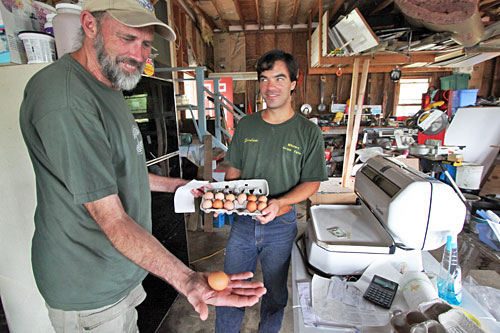
Our first stop was at Winters Grass Farm, located about 50 miles south of the Inn and just outside the Park boundaries. The Winters family purchased the farm in 1999 and turned over its operation to Jordan, who follows environmentally-friendly pasture-based farming practices. After picking up twenty dozen eggs Jordan offered to show me around the farm.
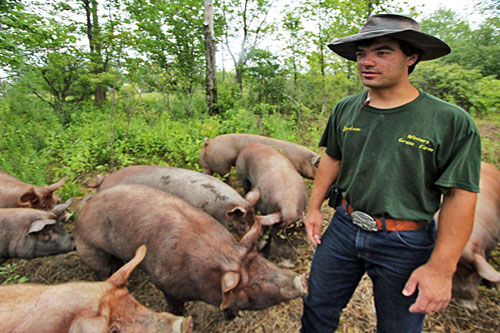
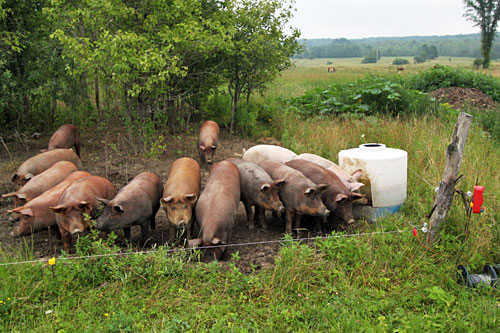
He led me across the street to a patch of land enclosed by an electrified fence, turned off the power and stepped over the wires into tall grass, motioning me to follow. “Here pig. Here pig, pig, pig.” he called. Nothing. Not a whisper of movement. We walked further back to the edge of a dense copse of trees, but still they hid. “They don’t know you; I’ll go get them,” he said, disappearing into the trees. Seconds later, a couple dozen huge hogs burst out of the forest and surrounded me. They leaned in, sniffing me with their enormous, wet snouts. I froze. “Will they hurt me?” I asked, alarmed. I’d heard stories about people being killed after falling into a pig pen. Jordan laughed and assured me I was perfectly safe. I reached down to stroke one and instantly pulled my hand back. “They’re bristly!” It was like petting a porcupine, without the stinging quills.
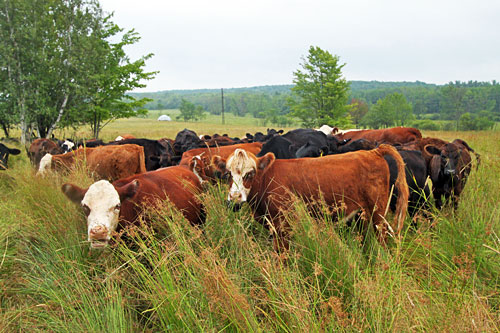
I followed him into an adjacent field and stepped gingerly around cow patties until I was face to face with a herd of brown and white faced cows. They chomped on clumps of grass and swatted flies with their tails while eying me suspiciously. As I got nearer they closed ranks and backed away from me. How strange, I thought, that great big cows are afraid of me while the smaller hogs were absolutely fearless.
Spotting chicken coops in the distance, I remarked that I was surprised by the lack of smell. Jordan explained that the farm is modeled after systems found in nature. In the wild, herbivores herd together for predator protection, are constantly moving to fresh ground and away from yesterdays droppings, and consume only forage as their diet. His herd is moved daily to fresh pasture and the cattle thrive on grass only. In the process, the land is allowed to rest, thus improving the landscape and increasing fertility. Chickens are kept in a portable hoop house surrounded by poultry netting to make an enclosed yard. They roam around freely in this yard and are moved every few days, along with the hoop house, to a new area.
The entire farm is run on principles that allow the animals to express themselves in ways that make them different from other animals. “Instead of raising our pigs in a building crowded together in a pen, we raise them out on pasture where they can root and graze, allowing them to express their pigness!” I giggled, remembering the “pigness” I had experienced just minutes before.
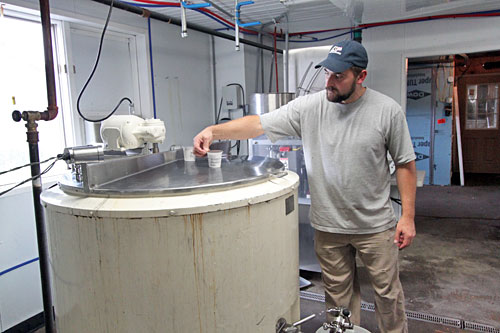
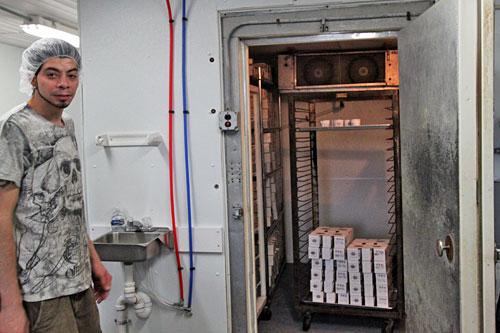
After a stop at Heidelberg Bakery to pick up bread for the week (and to grab a raspberry and cream cheese pastry for a mid-day snack), we continued on to Maple Hill Creamery for homemade yogurt. Partners Tim Joseph and his brother-in-law, Pete Heck, explained that their products are made the old-fashioned way – in small batches, by hand, right there on the farm. Their certified organic cows are outside all day, every day from April through October. In the winter they are housed in a spacious greenhouse-type barn, where they are free to eat, drink and lounge as they please. The cows are fed nothing but grass during the growing season, along with some salt and minerals, and only high-quality hay during the winter season. The result is delicious and healthy organic yogurt, lightly sweetened with organic evaporated cane sugar and natural fruit. Tim showed me the big vat where cultures are added to heated milk and the incubation room where the sealed cups are held overnight at 100 degrees. By morning the liquid magically thickens into European style “cream on top” whole milk yogurt.
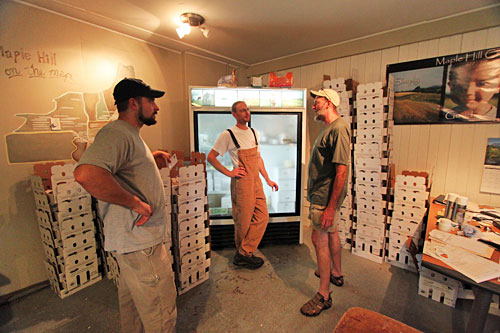
By the time the tour finished my mouth was watering. Hoping for samples of the plain, vanilla, maple, wild blueberry, lemon, and orange cream varieties, I eyed the cooler in the front office longingly. Tim grinned and pulled out a half-dozen yogurt cups. “These are our orphans,” he said. “We can’t sell them for one reason or another, usually because they’re the end of a batch and the containers are not completely full, so we let the community come in and help themselves.” Gleefully, I headed for the car, salivating at the prospect of lemon and orange flavors for dessert that evening.
It takes a special breed of person to make it in these hills; winters are brutal, the soil is too poor to farm, and other than working for the park service or in tourism, employment opportunities are scarce. But despite the challenges, it is clear that folks who live close to the land and embrace sustainability will endure, even in this unforgiving environment.

Barbara, thanks for the great read. I live close by, so I know all to well what the Adirondacks have to offer, I feel very lucky! Interestingly enough, I didn’t know the Arts were such a big part of the Adirondacks too. I’m going to try and check them out this summer.
Hello Barbara! I just want to say that you did an amazing job describing the heart of the Adirondacks. I was born and raised in the southern foot of the Park and I’m proud to call this place home. I refer to the rest of the region as my “backyard”, where I can go deeper into wilderness. I spent countless nights with my father staring at the extensive sea of stars, admiring the milky way and listening to him point out constellations. I grew up with deer in my yard nearly everyday and black bears bedding near my bedroom window. Exploring the woodlands barefoot, growing up a 3 minute walk to Mountain Lake, where there is so much history on its own (my late grandfather filled my head with wonderful stories of the haydays of Mountain Lake and even had postcards dated to those days. There used to be a trolley railroad that ran through Fonda, Johnstown, Gloversville and up into Bleecker where the Park begins. A horrible collision down the steep path ended the golden era of Mountain Lake, but today seasonal homes surround the calm lake and a few residents still live there, most who don’t even know the lush history that once laced the wooded area. There truly is no place like home. Too often out-of-staters assume New York State is NYC, but the majority of this big state is farmland and wilderness. I’m very glad to have come upon your writings, I found the article on Herkimer Diamonds & Barton Garners as I’ve always been a rockhound. Reading the rest of the articles I had to write to you. I’m also currently working on becoming an Aspiring 46er, which is a conquest to climb the 46 High Peaks of the Adirondack Mountains, the history in that is amazing as well and I can’t wait to be a part of that list of hikers (my biggest inspiration is Grace Hudalowski who is ADK46er #9 and was the first woman to achieve this and started when she was 15 in 1922, which was bold since outdoor recreation was seen as a masculine activity back then, she was founder of the 46ers Club and was very active with Aspiring 46ers for years until 2004 when she passed away, and just recently they changed East Dix Mtn. to Grace Peak in her honor. She’s increasingly being featured in local museums of the upper ADK region. I can go on and on about her). The Adirondacks are certainly a unique place, where the weather changes on the whim but every turn of nature offers something inspiring. As the cities demand more and expand, the rest of us are struggling more and more, but this is home and I wouldn’t want to be anywhere else. Thank you so much for what you do.
Dear Kayla: You have made my day with your comment! Thank you so much for your kind words about what I do. Your childhood sounds idyllic; if only every child could have such an experience it would be a much better world. Wishing you great success with your goal of becoming an Aspiring 46er – with my bad hip and knee I cannot do rugged climbs anymore, and I dearly miss it.
I just spent the morning with Judy Damkoehler at the Unitarian Church in Barneveld, NY, and what an lovely, interesting lady. Enjoyed reading your column. Interesting folk. Keep writing.
What a great article about Piseco Lake places and people. I have spent many stress relief days and nights at Piseco and happily stayed at the Irondequoit Inn(dogs were allowed at the time). The “Deep Woods” are a place apart! Hello to Judy Damkoehler. We have dear friends in common.
What a wonderful story and histoy! The pictures are besutful. I found this article very interesting.
Thank you boomer places. I love hearing that people are actually reading what I write. Have a wonderful day.