
Curacao island may be the Caribbean’s best kept secret. It is perhaps best known for the vividly painted waterfront buildings in the capital city of Willemstad. This neighborhood, known as Handelskade, was developed after the Dutch claimed the island in 1634. Buildings tended to be two and three-story shops and residences built on narrow, elongated lots to maximize use of scarce land. In those early days, the only materials available for construction were mismatched bricks scavenged from ship ballast. Structures erected from the bricks were finished with thick coat lime plaster made from crushed seashells. Under the intense Caribbean sun, the lime-plastered facades dried to a dazzling white.
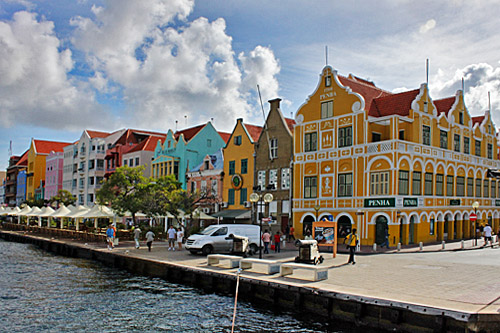
Local legend says that a former governor of the island suffered from severe headaches. He claimed his malady was aggravated by the sun’s brilliant reflections off the white buildings and mandated that building exteriors be painted any color but white. It later came to light that the governor was a shareholder in the island’s only paint store, but by that time, islanders had embraced the concept of painting their houses in vibrant hues. Today the tradition endures, making Willemstad’s Dutch and Spanish colonial style architecture one of the most delightful sights in the Caribbean.
Willemstad’s inner city and harbor, including the historic districts of Punda, Otobanda, and a smaller portion of Scharloo, were awarded UNESCO World Heritage status in 1997. All the districts are easily visited during a four-hour walking tour, which includes walking across the historic Queen Emma Pontoon Bridge, one of the oldest and longest non-military pontoon bridges in the world.
Can’t view the above slide show of Curacao’s stunning architecture? Click here.
Outside the city it is possible to visit some of the more than 80 surviving giant plantation houses known as Curaçao Landhuizen. Built in the 18th and 19th centuries, the hallmark of these plantation was the landhuis, where the master lived with his house slaves. The estates were surrounded by the store houses and huts of the slaves, all of which were constructed of traditional wattle and daub mixed with cow dung and roofed with dried maize stalks.
However architecture is not the only thing worth seeing on Curacao island. Divers will want to check out these top 15 Curacao dive sites. Many of the gorgeous white sand beaches scattered across the island provide excellent snorkeling opportunities. Christoffel National Park offers scenic drives, birding, hiking trails, and mountain biking. Not only does Shete Boka National Park offer blowholes and access to underground caves where giant waves crash in, it is also a favorite place for sea turtles to lay their eggs. The Kura Hulanda Museum, Klein Curaçao Lighthouse, Savonet Museum, and Fort Amsterdam round out the experience. For such a tiny island, Curacao offers activities and attractions enough to please even the most intrepid traveler.
Disclosure: Author Barbara Weibel visited Curacao island as part of a press trip, provided by the fabulous Marriott Resort and Emerald Casino, which is ideally located within walking distance of Willemstad.

Colourful buildings makes the city look disorganized as if they couldn’t agree with one another not even on a simple colour. Buildings would have been nicer if they stayed white.. look at Papagayo resort at Jan Thiel
Interesting to hear your opinion Meike. I rather prefer the bright colors over the white, though I can also appreciate the stark white as in Mykonos or Santorini.
Instead of ‘lining the Curacao waterfront in Willemstad’ should it not read ‘lining the Willemstad waterfront in Curacao’? After all we wouldn’t say ‘lining the American waterfront in Manhattan.
You are absolutely right Norma and I have made the correction. Can’t believe I didn’t see it before. Thanks for taking the time to call it to my attention.
The headache theory is a myth however. GREECE has several white buildings and no one complains about headache there. Furthermore, the Mediterranean sky is always clear compared to partly-cloudy Caribbean. So there is no evidence support that white coloured building give headache.
Hi Mark: That was kinda my point as well. Makes the fact that the governor of the island at the time the decree was made was a major shareholder in the only paint store on the island even more suspicious.
I love Curacao! The colors, the architecture, they are a great sight! Good read, thanks for posting.
I can certainly see why the town has got World Heritage status, that place is just beautiful. Love the colors!
Love the bright colors. Great back story, too.
I love it – supply and demand at it’s best – even though it was fabricated. The result is some stunning buildings…and great photos ops!
Great marketing ploy by the governor but at least with a beautiful and colorful effect. I like architecture with lots of color and variety.
So pretty — I love the colorful architecture. Seems like a great blend of European and Caribbean influences.
There is a similar-ish story to the bright colours in Buenos Aires charismatic area of Caminito (http://www.travel-wonders.com/2009/02/colourful-caminito-buenos-aires.html). This looks a great area for photography and I love the tall Dutch gables.
Architecture and colours are stunning. I can’t compete with my orange living room wall and Provence yellow/white bathroom 😉 What a savvy marketer the governor was 🙂
That’s a great story about the bright white headache-inducing buildings, I suspect the paint store ownership was closer to the mark. You can see the Dutch influence in the style of the buildings and the birght shades indicate you’re in the tropics.
Ha! Isn’t it always the case. He had shares in the paint store. But I’m so glad he did. The town is a beauty.