
Exploring the back roads of Hatteras Island in search of old homes that have weathered scores of hurricanes and provided shelter for generations of fishermen is one of the many delights of any visit to the Outer Banks. The Old Gray House, tucked into the woods just off the main road in the tiny village of Buxton, is one such structure. If only this house could talk it would tell many tales. Fortunately, the home’s current owners, Dewey and Mary Parr, are happy to speak with visitors about their homestead.
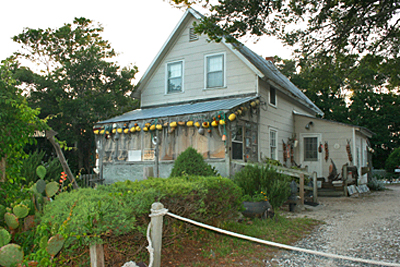
The Old Gray House takes its name from a seafaring family by the name of Gray, whose descendants have inhabited Hatteras Island since the early 1600’s, beginning with Dewey’s great grandmother, who was shipwrecked on Hatteras Island. She was on board a ship coming from Newfoundland that ran aground and, transportation being difficult in those early days, she just stayed on. Dewey’s early years were spent in Buxton, but during World War II the family relocated to Huntington, West Virginia where his father was stationed as a Navy recruiter. After the war was over Dewey remained in Huntington, where he met and married his wife, Mary, and pursued his career in education. Dewey served as teacher, principal, and central office administrator, but he and Mary returned to Buxton every year to vacation at the family’s cottage.
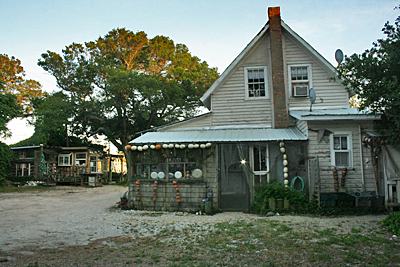
As they grew older, Dewey and Mary began to consider how they would spend their retirement years. Mary had always dreamed of having a little gift shop, full of hand-made items she could share with others. Dewey’s dream was to spend his days puttering around with plants, entertaining tourists, and roaming the beach in his four-wheel buggy. By this time, Dewey had already retired, however Mary could not be persuaded to stop working. For three years, Dewey secretly worked on his grandparents’ old homestead and on Valentine’s Day, 1992, gave Mary the Old Gray House Gift Shop on the condition that she would finally agree to retire.
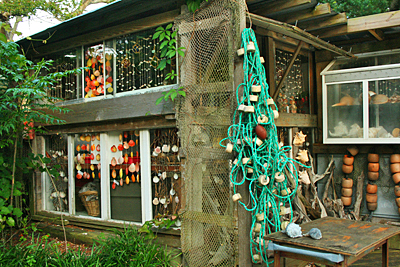
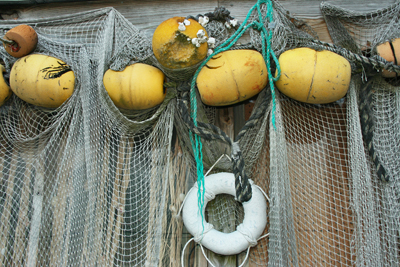
Today the entire home is open to the public for viewing and for browsing. Much of the Old Gray House was built from the scraps found on the beach, rafters from ships, and even shipping boxes that had been discarded from ships (sailors who used to pass by Hatteras Island would toss items overboard to help those who lived on the isolated island). In the main house, Mary has filled each of the rooms with unique and locally handcrafted items. The other structures on the site are Dewey’s domain. The old outhouse is now a library and the chicken coop is one of four buildings that offer shells from all over the world. The pathways that connect the various buildings are decorated with shells, old fishing floats, ropes, nets, chunks of coral, and an assortment of antiques. A teepee of fishing poles stand stacked and ready. Even an old bowling ball has been put to use: painted neon blue, it sits in the center of a birdbath that is tucked into an out-of-the-way corner where Spanish Moss hangs from the heavy limbs of Live Oaks.
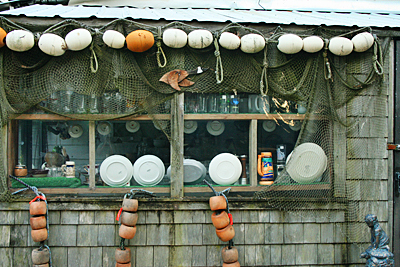
Tourists who find their way to this slightly dilapidated, very funky shop are regaled with legends and lore about the Outer Banks and the house (ask about the ghost that inhabits the house). A visit to The Old Gray House is more than a shopping experience. It is a history lesson, a biology lesson, and a geology lesson, all willingly and delightedly provided by Dewey and Mary Parr, who make it their mission in life to preserve the folklore of the Outer Banks.

My family and I will be traveling to the Outer Banks in 2 weeks. We are staying in Avon, but I have to make a trip back to the Old Gray House again. I love to explore and find some treasures there like I did last year. Im really looking forward to being there again !!
What a most wonderful shop.I remember walking into this shop, the year it opened.I was aw struck.My family has vacationed on the Outer Banks for over 35 years.We have loved every moment of it. My Mother passed away in August of 2007.We had been down in Hatteras in June of that year. My Aunt and her family, were in Hatteras in September. I asked my cousin Pam To tell Mary about Moms passing.When we went back the following year,the void without my Mother was huge. I would look out over the dunes to the beach and cry. It was just so hard without her.That year, I just was not up to going to a lot of shops and sightseeing. But I had to see the Old Gray House. When I pulled into the parking lot, I froze up.Tears were streaming down my cheeks. I could hardly get out of the car.My Mother loved this shop with a passion.Mary and Dewey were like family. .. Mary sent me the most wonderful card. It really helped me a lot.I would pull the card out of my desk. Look at Mary’s beautiful handwriting and read it over and over. When I saw Mary and Dewey that following year, Dewey was working in his flower garden. We talked and talked. I started to go into the screened porch.There was Mary, her back was turned to me. I wiped a tear and said, there’s Mary one of my favorite people on the planet! She turned around and said, JEFF! She gave me a huge hug.I am happy that I was able to contain myself.It was like old times again. We talked about my Mom, and how much she enjoyed the shop. I have never spoken to two kinder, gentle and loving people as Mary and Dewey.I think of them often. And I will love them and carry these two special people in my heart forever. Jeff Gardiner Hagerstown Maryland
Hi Jeff: All I can say is Wow! Thank you so much for sharing your heartfelt experiences at the Old Gray House. I have been back several times and was always welcomed like a long-lost member of the family, even though they have no idea who I am. It takes very special people to do that. I’m so pleased that my story brought back such wonderful memories for you.
What a hot topic to choose, good reading.
What a hot topic to choose, good reading.
Thank you for your wonderful story about our shop. Love your stories about your many travels. Will do our best to direct our friends to your great website. Dewey and Mary