
Having had my fill of art and culture, I headed for the district of Liguria, located in Italy’s northwestern corner where it borders France. Liguria forms an arc, with one side facing the Ligurian Sea and the other backing up against the Apennine Mountains. Better known as the Italian Riviera, it is a continuous line of rugged cliffs dotted with long beaches and lovely coves. The capitol of this district, Genoa, divides Liguria into two parts: the Riviera di Ponente to the west and the Riviera di Levante to the east.
While the Rivera di Ponente, with its famous San Remo, is more well known, it was the eastern part of the Riviera that interested me, with its lesser known and lesser visited Cinque Terre area. My train departed Pisa, quickly leaving behind the Tuscan hills for more rugged terrain. We rolled through a dozen towns that clearly owed their prosperity to the mountains – factory yard after factory yard was filled with giant chunks of exquisite Italian marble and sparkling granite, drilled from the faces of the Apennines. The train terminated in La Spezia, the southern terminus of Liguria and the location of my hotel for the next three nights. La Spezia is a convenient destination for visiting Cinque Terre – trains run around the clock to all five villages, with the furthest village requiring only a 25-minute ride at a price of slightly more than five Euros. A ferry also runs during daylight hours, although the sea option takes two hours.
In Italian, cinque means “five.” In medieval times, the word “terre” (land) meant village, thus the name Cinque Terre. These five tiny villages: Monterosso al Mare, Vernazza, Corniglia, Manarola, and Riomaggiore, cling impossibly to rocky bluffs suspended over the cobalt and turquoise waters of the Tyrrhenian Sea. Beginning in the thirteenth century, generations of local farmers carved steep terraces sloping down to the sea, held up by over 7000 kilometers (about 4200 miles) of stone walls built without any kind of cement. These terraces are cultivated primarily as vineyards that produce wines coveted throughout the world, although there are also lemon and olive orchards that produce heavenly olive oil and a much-sought lemon liqueur. A relatively new crop in the hills is basil, from which an award-winning pesto is produced.
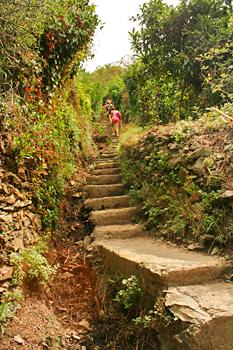
One of the best ways to experience this region is by hiking Cinque Terre on foot, using a series of ancient paths and centuries-old flights of steps carved out of the surrounding rock. Until recently these paths were the only communication routes between the five villages – the rail line was tunneled into the sea wall along the coast just thirty years ago, and the road that winds along the top of the cliffs still does not directly access all five of the villages. I had read that the path between Monterosso al Mare and Vernazza was the most rugged and unimproved portion of the trail so I decided to begin my journey there and walk east until I had visited all five villages.
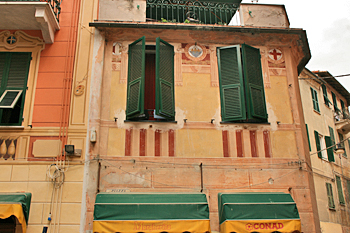
I stepped off the train in Monterosso and was instantly stunned. Unlike Tuscany, with its predominant brown, gold, and terracotta color scheme that quickly bores, the villages of Cinque Terre are awash in vibrant color – ancient houses buttressed up against one another painted in rose-petal pink, salmon, sky-blue, burnished gold, lemon yellow, and seafoam green.
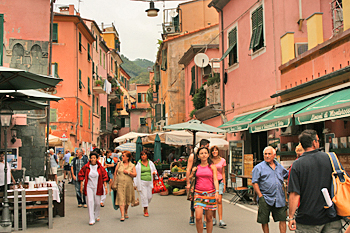
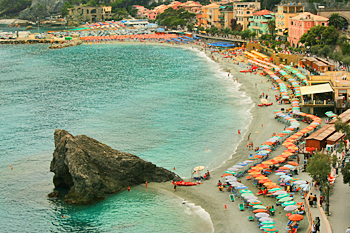
Across the courtyard at the seawall I looked down upon another riot of color – multi-hued umbrellas lined the long expanse of beach lining the Tyrrhenian Sea, so clear I could see the rocks on its bottom through its turquoise waters.

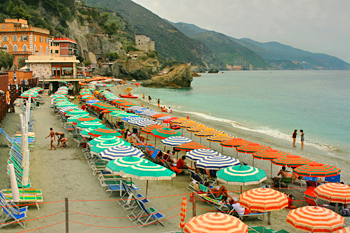
I strolled to the end of the promenade perched above the beach and began hiking Cinque Terre along the famous footpath. Around the first rocky outcrop was yet another beach with more colorful umbrellas, a “suburb” of Monterosso that has sprung up in the days since the railroad arrived.
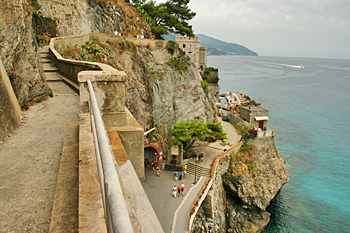
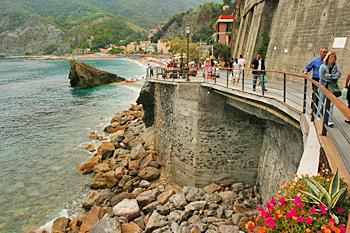

At the end of Monterosso’s second beach I began the long, arduous climb up the face of the cactus-peppered cliff toward the second village of Vernazza, looking back for a final view of Monterosso from the heights.

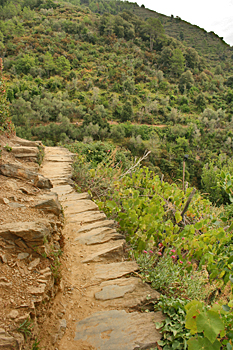
As I climbed, the path became more treacherous, at times narrowing to only 18 inches wide, the mountain on my left and a sheer drop to the sea on my right with not even a hint of a guard rail. In many places the path was not wide enough for two people – more than once when encountering hikers going the opposite direction I had to back up until it widened enough for passing. Strangely, this did not bother me at all and I thought back to a similar hike I made some months ago on the island of Waiheke in New Zealand, when I became so panicked by the dizzying heights that I had to make myself breathe. Somehow, over these many months of travel I have become more confident in my abilities. This trip has changed me in many ways – but that is a discussion for some later story.
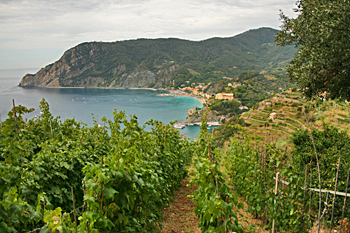
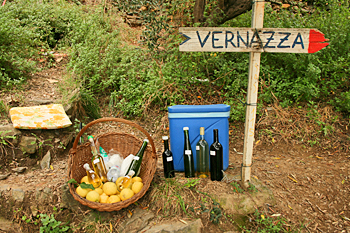
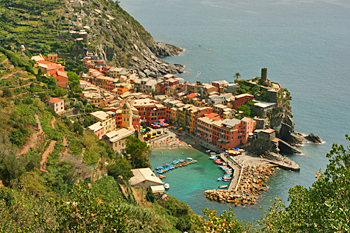
The hike between Monterosso and Vernazza is perhaps the most spectacular part of the path, winding up and down between ancient stone walls that enclose vineyards heavy with blue, green, and gold clusters of fat juicy grapes, nearly ready for harvest. During the month of September workers pick these grapes, carrying them out of the hills in baskets strapped to their foreheads. At one point I rounded a corner on the trail to discover a basket set out with an offering of local wines, liqueurs, and citrus for sale. One and a half hours after leaving Monterosso the trail began its descent into tiny Vernazza, with its crystal harbor, colorful piazza, and pocket beach – also a stunning village and the only one where the train comes right into the center of town.
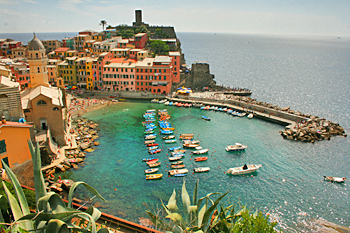
I stopped for lunch in Vernazza. Beneath a shade umbrella at a beach-side cafe, I indulged in a cold salad of fresh tomatoes, marinated octopus, and fresh Monterosso anchovies that are caught at night using special lights to attract the fish.
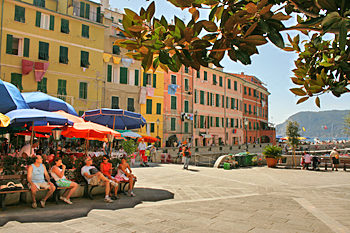
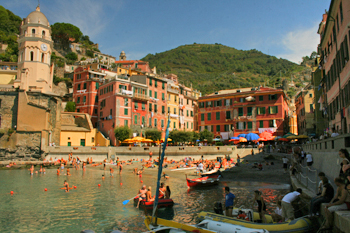
For a couple of hours I enjoyed people-watching. Locals exchanged news while relaxing on benches scattered around the square and tourists sunned themselves on the beach. As the sun began to dip I again set off on the trail, this time destined for Corniglia, the only of the five villages not located directly on the sea, but nestling on a hill surrounded by vineyards. Midway between Vernazza and Corniglia I came upon this “bar” high up in the mountains in the middle of nowhere.
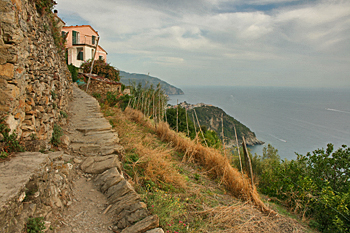
Surely, I thought, it must only be open during daylight hours, as I could not conceive of people drunkenly stumbling home along these paths in the dark. Before long Corniglia came into view – yet another wondrous spectacle of cliff-top architecture.
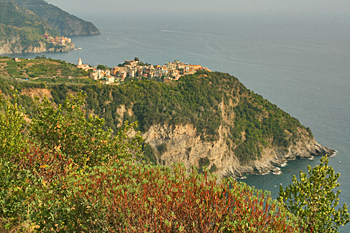
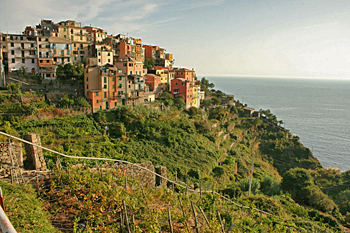
Although a pretty little town in its own right, it didn’t take long to investigate Corniglia – there is little here other than an old church. There were some hours of daylight left and I could have pushed on but I chose to end my day here, as I did not want to rush the experience. Tomorrow I will complete hiking Cinque Terre, beginning at the easternmost village of Riomaggiore and working my way back to Corniglia.
Author’s note: While taking the train will provide access to the five main villages of Cinque Terre, a road trip around Italy is an even better option. Monterosso al Mare offers parking facilities, and having a vehicle ensures you can visit even more of the tiny cliff-hanging villages scattered around this fascinating region.
Read Part Two about the Walking Trail between the Italian villages of Cinque Terre, Italy

Dear Barbara,
Your trip looked amazing and i\’m absolutely in love with all the beautiful photographs
Just wondering if its possible to somehow get any copies of the photos in high resolution?
Thank you so much
Poppy
Hi Poppy. I’m happy to discuss selling any of my photos, Poppy. If interested, please email me at [email protected]
Thank you for a beautiful introduction to this area. We are hoping to visit there someday soon. You show the difficulty and the ease of the hikes.
Your photos are stunning.
Thank you so much Allain. Glad you found my story helpful. I understand it has become a very popular tourist destination since I was there, so it’s best to go in the spring or fall rather than the height of the summer.
loved your photos and you’re inspiring me to visit that place someday; not sure if am surefooted like you. reading your experience made me feel like am there, walking with you!!! will surely continue reading your travels Barbs!
Hi Fe: I think back to that hike, and now that I’ve done so many others, I suspect it would be much easier than it was back then. It is a magnificent hike, if you ever get the chance, do it!
I loved my trip to Cinque Terre years ago, and was incredibly saddened when I heard it had been affected in recent years by storms and flooding. Doesn’t look like it’s doing too badly from your photographs though. Great account of your visit there 🙂
Hi Catherine. Yes, I read about the floods, the worst of which were in Vernazza, I believe. Hopefully, they’ve come out of it OK.
Dear Barbara,
the Cinque Terre in Italy is fantastic location and your article & photos are incredible!
My compliments!
Regards,
Minicity