
More than the fishy, slightly salty taste of squid cooked in its own black ink or the melt-in-your-mouth sweetness of fruit-shaped marzipan candies. More than the play of sunlight over the narrow canals, their rippling green waters reflecting distorted houses each time a gondolier glides past. More than the vague scent of sewage and the stink of rotting food rising from piles of uncollected garbage. More than any of these things, for me it is the sounds of Venezia – Venice – that define this slowly sinking island city.
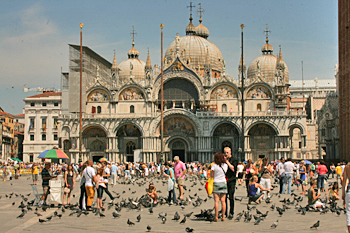
Venezia is thousands of bells atop hundreds of churches, faithfully and clangorously ringing the hour and half hour. It is the Shrussshh-shussh of a thousand pigeons simultaneously taking wing from San Marco Piazza. It is the gondoliers, breaking out into passionate song as they ply placid canals in their black lacquered boats. It is fifty different languages from thousands of tourists melding into one unrecognizable din. It is the banging of dumpsters being filled by late night clean-up crews and the clacking of rolling carts bouncing along the stone-paved streets in the pre-dawn darkness, delivering goods for the next day. And always, it is the sensual cadence of the Italian language, whether spoken in hushed tones by elderly men hunched around a tiny table enjoying late afternoon espresso or screamed by gondoliers who hurl insults down canals at competitors encroaching upon their territory.
From the moment I arrived in Italy I felt the shift. As we crossed the Swiss border and traveled toward Milan the stunning scenery of the Alps gave way to flat, uninteresting plains. The lovely wooden chateaus of Switzerland were replaced by boring multi-story poured concrete houses. Yet I also could sense that the cold aloofness of the Swiss had been replaced by a passionate Italian energy. There is no reticence here. The Italians tell you exactly how they feel – they are not ones for mincing words. I resonate with this energy. I feel like I belong – like I am no longer walking on eggshells as I was in Switzerland.
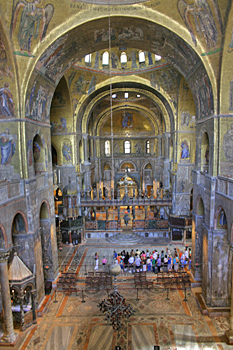
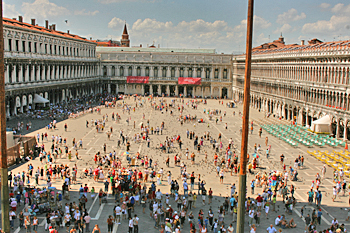
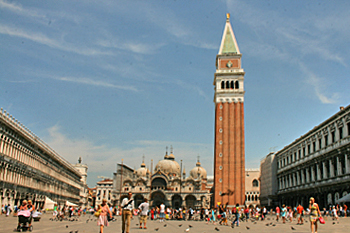
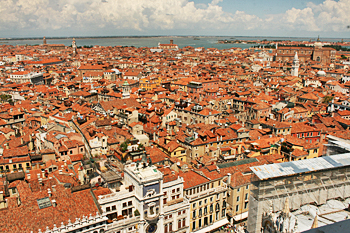
My first stop in Venezia was at the famous San Marco Piazza (St. Mark’s Plaza), where for one Euro, you can buy a bag of corn to feed the pigeons. Not much spooks these birds, as they are used to people and even more used to being fed – in fact they are so bold they will perch on the head, shoulders, or arms of anyone offering food. St. Mark’s Basilica, a superb example of the Romanesque -Byzantine style with five cupolas, was built in the 10th century and today dominates one end of the plaza. Originally built to house the body of St. Mark the Evangelist, the facade features five portals decorated in marble and mosaics. The imposing interior is built in the shape of a Greek cross with walls that are covered in gold mosaics of Veneto-Byzantine origin and artwork that is studded with thousands of semi-precious jewels. Although photography was not permitted inside the Basilica, no one seemed to be watching, so I used the “no-flash” setting on my camera to capture this shot from the second floor, then stepped outside to the balcony to take a (permitted) photo of the Plaza, with its crowds of tourists and pigeons far below.
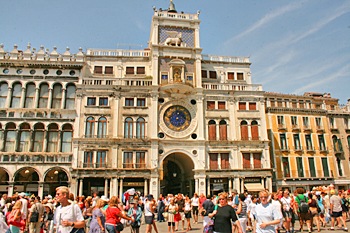
On one side of the Basilica stands the 15th century Torre dell’Orologio. On the terrace at the top of the tower two bronze figures, The Moors, strike the hour against a large bell. The face of the tower contains the complex clockwork mechanism and the great gold and blue enamel clock face that indicates the hour, the phases of the moon, and the motion of the sun. On the opposite side of the Basilica is the Campanille, or bell tower. Originally built as a lighthouse, today its main function is to carry tourists to the top via a small elevator for a bird’s eye view over the red tiled rooftops and church steeples of the city.
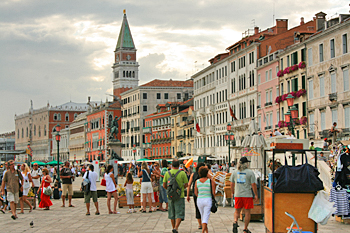
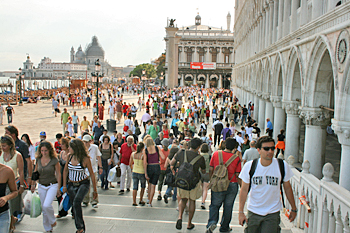
Leaving the plaza, I headed out to explore the myriad things to do in Venice beyond St.Mark’s Cathedral. I follow the broad promenade along the Grand Canal toward the Ponte (bridge) della Paglia. From the top of bridge I looked back toward St. Mark’s Plaza to see thousands of people streaming out of the square and onto the promenade. The crowds of tourists in Venezia in August are absolutely suffocating. People walk about like a herd of slow-moving cattle and think nothing of stopping dead in their tracks in the middle of a crowded bridge to examine a map or strolling slowly down a narrow alley, four-abreast, so that no one else can pass.
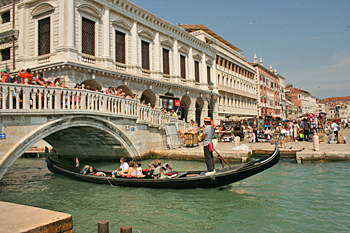
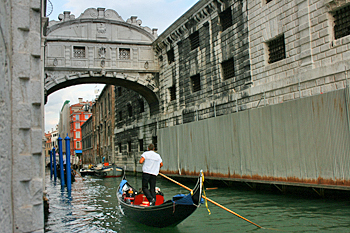
I paused long enough at the top of the bridge to look down the canal at the Ponte dei Sospiri (Bridge of Sighs), so named because it connected the old and new prisons and it was said that the sighs of the prisoners could be heard from the tiny cell windows that looked out over the Venetian bay.
I have been wandering the historic streets of Venice Italy for two days, armed with a map of the city provided by the Tourist Bureau. Unfortunately it is almost useless, since the map is in Italian and the street names on the brick walls are in Venetian, which is an altogether separate language. At every twist and turn of the narrow streets and alleys I ran into tourists with maps spread out before them, puzzling over how to get to some destination or figure out were they are – but that is part of the fun of Venezia. You must either be glued to the map with every step or give yourself over to the experience and just wander, so mostly, I wandered. I walked along the banks of the Grand Canal, watching its varied boat traffic.
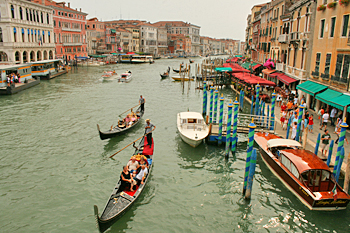
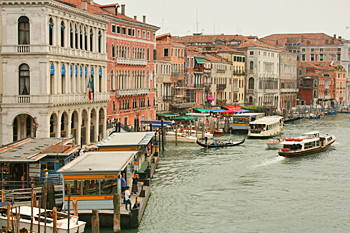
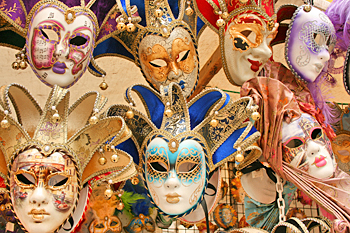
I crossed the famous Rialto Bridge, with more than 20 shops lining its central passageway, offering anything from food to glittered porcelain carnival masks.

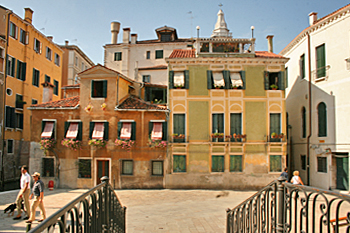
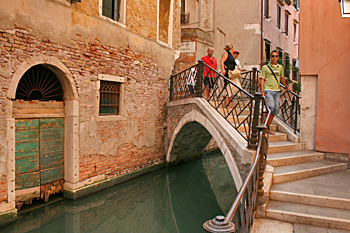
I randomly turned down alleys that looked unlikely to lead anywhere, only to discover that they opened onto broad plazas or led to charming little bridges over a plethora of canals.
Gondoliers were everywhere – in some places the traffic jams on the waters were just as bad as on the streets:
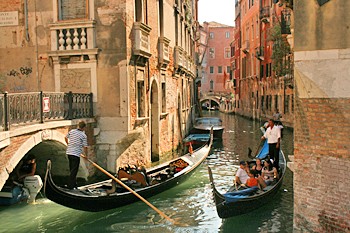
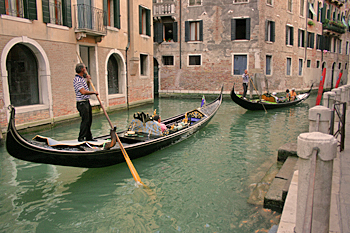
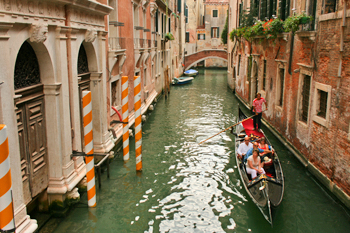
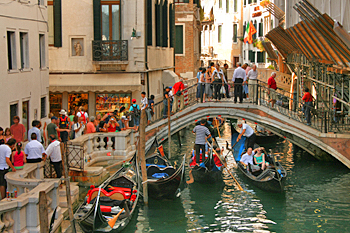
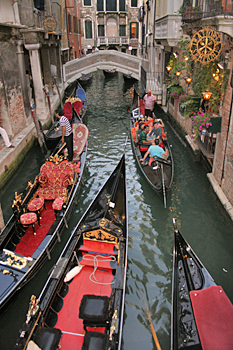
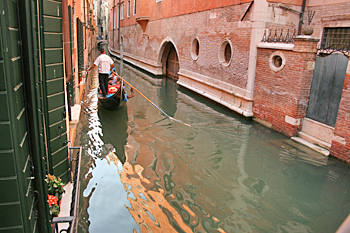
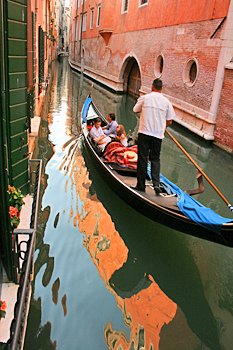
On day two I had planned to see the Venice Lagoon Islands by Vaporetto, but I simply couldn’t tear myself away from the city center. Instead, I hooked up with two other tourists from Holland who wanted to take a ride in a gondola. We split the cost three ways – 27 Euros each (about $35 US). The view from the water is astounding. From this vantage you can really see the effect of the continued sinking of the city – many homes have abandoned their first floors entirely and now live only on the upper floors. From the gondola, colors seem to be even more saturated, the deep ochres and rusts of the buildings reflecting into the green water of the canals.
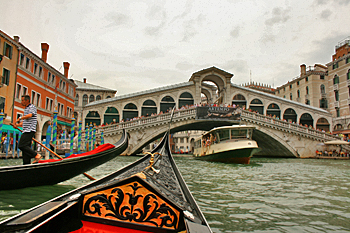
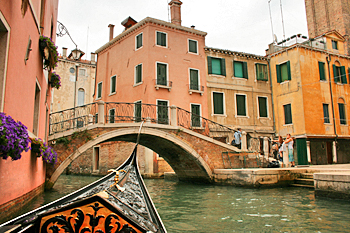
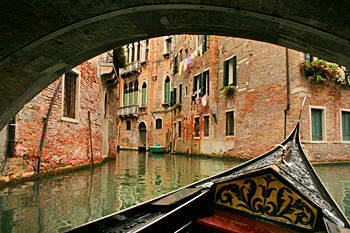
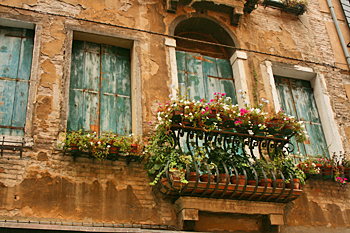
With all this beauty it would seem a simple task to take good photos here but quite the opposite is true. The tall buildings that line the narrow canals keep the water in shadow most of the day, thus when there is light enough to get a good shot, it is harsh, midday light. I was fortunate to find a few places that were conducive to good photos, including this spot, where I took these two shots, which I believe to be among the top five photos I have taken during this trip:
More later – time to go get lost again!

Hiya! I know this is kinda off topic however , I’d figured I’d ask. Would you be interested in exchanging links or maybe guest authoring a blog post or vice-versa? My website discusses a lot of the same topics as yours and I feel we could greatly benefit from each other. If you happen to be interested feel free to send me an email. I look forward to hearing from you! Fantastic blog by the way!
Love the last shot with the elongated canal, reflection in the water, and bright turquoise cloth on the gondola.